The Sparrowhawk, Fence, Lancashire Taste Lancashire Produce Evening with Leagram Organic Dairy 11th July 2012
Disclosure: I attended this evening as the guest of Visit Lancashire, but I have not received any payment, nor even travel expenses for attending or writing this article.
This was the last in the current series of Taste Lancashire evenings, where Lancashire restaurants have been teamed up with a local producer to showcase both the restaurant and the producer. On this occasion the restaurant was the Sparrowhawk in Fence, and the producer was Leagram Organic Dairy of Chipping.
Luke Payne
Interestingly, the Sparrowhawk had, earlier in the year, run a little competition among the kitchen to design a menu for tonight, and the winner was eighteen-year old Junior Chef de Partie, Luke Payne, who became head chef for the evening to deliver his menu. It was perhaps a little unfortunate that he had designed the menu much earlier in the year, and so it was certainly substantial. But there's no denying it was a very creditable performance on the night: congratulations to him and the management of the Sparrowhawk for giving him this opportunity.
The Lancashire Foot is Lancashire's version of the Cornish pasty, once a staple meal for the county's miners. Here it was filled with Leagram's Lancashire and onions into a small starter-sized (phew) pasty. The other tarter, which I had, also featured Leagram's cheese, here in a very tasty, but nicely balanced rarebit topping on a piece of haddock that was just a bit too thin, and got lost between the rarebit topping and the tomatoes. The menu doesn't say, and I forgot to ask, but I hope they were Lancashire tomatoes: Blackpool, Ormskirk, Southport etc. were all centres of marketing gardening in the 20th century, and still produce tomatoes commercially, as does Burney's of Clitheroe (just the other side of Pendle Hill). I thought that if the tomatoes and rocket had been passed through a light dressing, that would have improved the dish a lot, as it was a little dry overall.
Smoked haddock rarebit with tomato salad
Rag pudding is a steamed suet pudding, not unlike spotted dick, often traditionally cooked in a shirt sleeve, and served in either sweet, or (as here) savoury forms. Unfortunately, it was a steamy hot evening and nobody on my table had the rag pudding. On reflection, my gastronomic curiosity should have won the day, rather than the "safe" lamb option, as I suspect it probably wouldn't have been as heavy and hearty a dish as it sounded on first reading the menu.
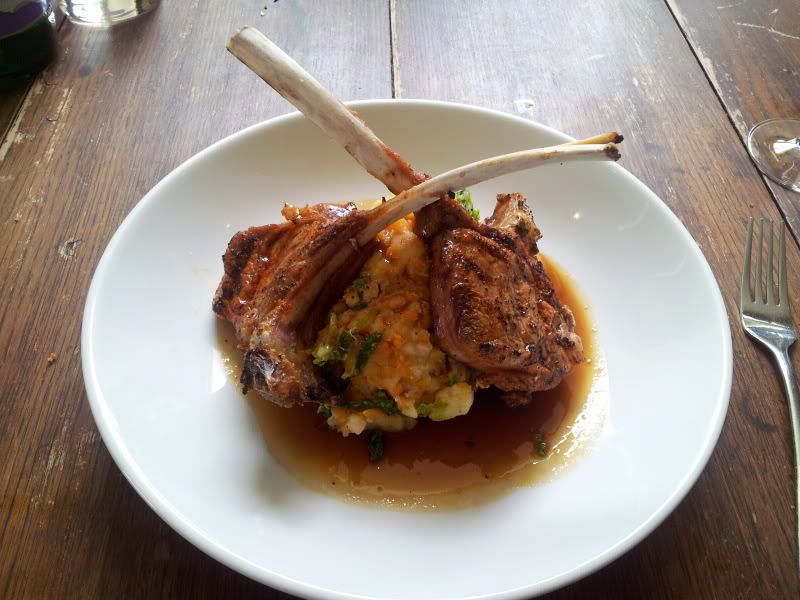
Rump of lamb with rosemary hash brown, minted pea purée and balsamic jus
This was some very good lamb, nicely cooked, though I thought that it could have been a little better trimmed. The minted pea purée was a delight, and beautifully cut the richness of the lamb and the gravy (which was, thankfully, not overly balsamic). For me, the disappointment was the "hash brown" which didn't really seem to be what I think of as a hash brown, and was if anything closer to a heavy version of the classic pommes dauphine. I didn't pick up much of the rosemary that was supposed to be in the potato either. A bit of work on the potato, and this would be a super dish.
Before dessert, platters of various Leagram cheeses were brought round for tasting.
The
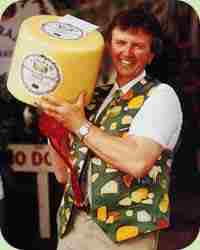
irrepressible Bob Kitching
Leagram Organic Dairy is based in the pretty Ribble Valley village of
Chipping, one of the newest producers of Lancashire cheese.
Leagram are well known both locally and further afield, not just for
their cheese, but also for Bob Kitching's cheesemaking demonstrations
and his cheese waistcoats and ties.
Bob runs the dairy along with his daughter Faye, and it was Faye who
joined us at the Sparrowhawk to talk about the dairy and its products.
Faye
Kitching (apologies for the photo which
makes it look like she's conducting the restaurant in singing the
Cheese Chorus)
Leagram currently make some 28 varieties of cheese. They produce a wide
range of what I call cheese with bits in, a style of cheese which I abhor, but also make
the usual range of creamy, crumbly and tasty traditional Lancashire
cheeses. I had always thought these were essentially the same
cheese at different stages of development, but apparently that's wrong,
and the cultures used are slightly different for the three
styles. My favourite of the traditional Lancashires (though
sold in a less than traditional cone shape) is the 2 year-old tasty,
sold under the name "Bob's Knobs" (or in the slightly prudish Booths
supermarkets as "Volcano"). There is an excellent blue
cheese, made in quite a creamy, Italianate style. But, besides the traditional Lancashires, my
favourite of all the Leagram's cheeses are the really fresh one-day old
curd cheeses (the Ramshackle sheep's milk version was here for
tasting), which are pretty unique. As well as on their own,
with fruit and/or honey, or grilled on a crumpet, or even bruléed as a dessert, they make a superb
British replacement for the queso fresco used in many Mexican dishes. Well worth seeking out.
Both the desserts were unqualified successes. The apple pie was reported to be have just the right hint of spices, and certainly looked the business. The ice-cream, made with Leagram's Lancashire Cheese, had everyone in raptures.
Spiced apple pie with Lancashire cheese ice cream
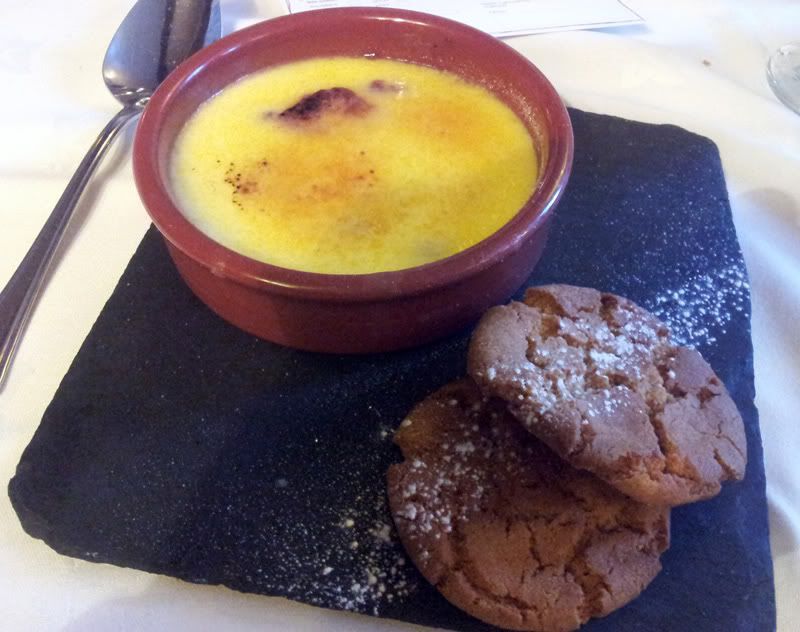
My rhubarb crème brûlée really couldn't be faulted. Great custard on lightly spiced (ginger?) rhubarb, with the thinnest, most delicate glassy brûlée topping. The two ginger biscuits served on the side were jolly good too. The Sparrowhawk needs to put this on its main menu as soon as possible.
Rhubarb & Custard Crème Brûlée with homemade gingerbread biscuits
Remarkably for such a small place, there are two pub-restaurants in Fence, both with good names for food: The Fence Gate Inn and The Sparrowhawk. Obviously, this wasn't a "normal" meal at The Sparrowhawk, but the atmosphere, service and food all seemed to me a notch above their competition, and I hope to return soon.
Cail Bruich is in Glasgow's West End, near Glasgow University on the Great Western Road. It's not one of the most prepossessing stretches of that road, and I'm afraid my photograph of it in the morning and in the rain, does not make it look any more attractive. At night, however, the blinds are up and there's a subdued warm glow from the dim lighting inside. The entrance has a nice feel with a plush curtain around the door, keeping the draughts out. Inside, there's a vaguely French brasserie cum bistro feel: a bit old-fashioned, but nice and comfortable.
I apologise for the poor quality of the following photographs, not least to the chef, as they really don't show off his food at all well. But it was really quite dark in the restaurant, and I don't want to use flash.
With my aperitif they served some very good little gougères and some black and green olives. The green olives were ok, but the black ones were fabulous.
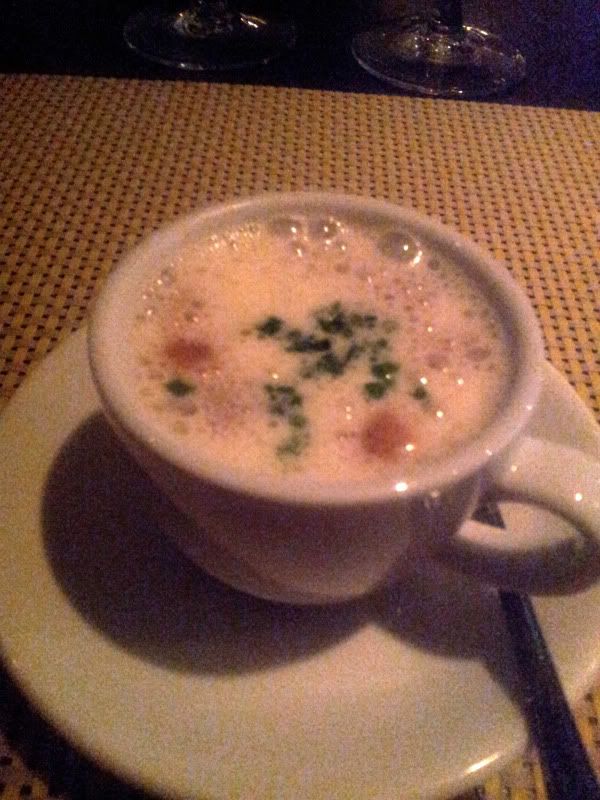
Cullen Skink
A demi-tasse of cullen skink was served as an amuse bouche. This was one of the best cullen skinks I've had: packed full of smokey fish flavour (and bigger chunks of fish than you'd expect in a demi-tasse), finely diced potato and avoiding feeling at all over-salty.
Smoked pigeon with pickled vegetables and sultana & caper dressing
I started with smoked Perthshire pigeon, which came with Noma-esque pickled vegetables, goat’s curd, and a sultana & caper dressing. I was initially a little dubious about smoked pigeon, and expected to be at best ambivalent about it. But I thought it worked really well, with the smoking accentuating the gamey liverishness of the pigeon breast. If I were being hyper-critical, I'd say that the pickled vegetables could have been sliced a little thinner.
A truly awful picture of the lettuce, lamb and peas. Sorry. But it shows the plating at least.
My main course was an assiette of lamb with lettuce and peas. The loin was perfectly cooked, and a sweetbread similarly so. A couple of tortellini were filled with, I think, probably slow-cooked shoulder. The grilled lettuce, and the peas and pea purée naturally went very well, though personally, I'd have liked the peas to have been a little more cooked.
Tapwater is provided automatically, and kept re-filled. I just had a glass of an interesting Languedoc red, L'Infidèle that was fine with the pigeon, but worked best with the lamb.
Blueberry chibouste with mascarpone, cucumber and basil
Desserts were interesting, and all appealing, but it was the combination of blueberries, cucumber and basil that most caught my eye. This worked well, though I thought it could have been improved by taming the rawness and power of the herb somewhat, perhaps by candying it, or turning it into a syrup. A very fresh-flavoured, light dessert.
This was a very enjoyable meal. Some interesting combinations, backed up by extremely able cooking and technique in the kitchen. Front of house worked very well too, striking just the right balance of efficiency and friendly interaction with the customers.
Downham is an improbably pretty village below the brooding presence of Pendle Hill near Clitheroe. Many improbably pretty villages are described as unspoiled: Downham really is, as virtually all outward signs of modern life (TV aerials, satellite dishes, double yellow lines, overhead cables etc) are banned by the Assheton family, lords of the manor since 1558.
The Assheton Arms had a good name for food, and a bit of a leaning towards seafood, for many years, though it had started to go downhill and was looking a bit uncared for until it was put on the market. There was talk that Marco Pierre White was buying it, but towards the end of 2011 it was Jocelyn Neve's Seafood Pub Company that took on the lease, opening briefly for Christmas before embarking on a major (and much overdue) refurbishment.
The Assheton Arms, Downham
The exterior is, of course, unchanged, and I was surprised how much of the interior layout remained recognisable from its previous reincarnation. There is still the tiny bar opposite the door as you go in, but the dining area around the central chimney breast has yielded to a presumably extended kitchen. More seating has been added (?) over two floors of the adjacent building (clearly distinct on the right in the photograph above), including a private dining room. This building has been linked to the Assheton Arms for as long as I can remember, but I do not recall it ever being used; the door through to it being marked merely as the ladies' toilets.
The decor shows the same hand as their sister pub-restaurant, the Oyster & Otter in Feniscowles, though it feels much less sterile here. I also thought service too, from the welcome and throughout, was markedly better here than at the Oyster & Otter.
On the way to our table I noticed some blackboards with a handful of specials, and lots of room for more, presumably at busier times. The waiter then reeled off the specials at the table: we had to ask him to repeat them twice, and still don't think we could have said what they were all. Laser printers are so cheap these days, and cheap to run, that I don't know why more restaurants don't print specials menus on a daily basis. If you've more than three or four specials, it would make life so much easier, and I suspect you'd sell more of them.
We had a mixed platter of seafood items to start with, which conveniently included many of the starters on the main menu.
Seafood Platter
King prawn sesame soldiers were ok, but the prawn flavour was a little overpowered: I'm not sure if there is a particular benefit to using king prawns over regular cold water prawns on prawn toasts. The salt and pepper squid was certainly salt and pepper, though again, I thought there was too much emphasis on the crispy coating, leaving the squid as merely a carrier. I have had more tender squid, but there was nothing to complain about on that count. The rice wine and radish dipping sauce that came with the squid was terrific with well-nigh perfect balance. The lemon mayo that came with the shell-on king prawns was also very good, and the prawns themselves were good quality. Some herby fish fingers were also very good, but were a third deep-fried element on the platter, which seemed maybe one too many to me. There were a couple of pieces of good smoked salmon on the board too. But for me, the highlights (besides the dipping sauce for the squid) was some really good devilled crab and some gorgeous cockles in a very light, possibly gently spiced vinegar. I would have really appreciated more of the cockles.
From the specials menu, we had a second starter of mackerel, which I think the waiter had said came with an oriental dressing.
What was supposed to be oriental seemed to me to be more of a Moroccan-spiced tomato fondue, and was absolutely delicious. I thought it would be great on potatoes, like patatas bravas, though it worked very well with the mackerel, which itself was clearly good and fresh and also nicely cooked. You'll see in the picture above that the mackerel came on some salad: this contained some pomegranate and some raw carrot that was just a bit too chunky. There were also a couple of small black things that didn't look like pebbles, but had all the digestibility of pebbles. I asked the waiter to point them out to the kitchen and ask what they were: the response was that the kitchen hadn't a clue what they were. Glad that was sorted then.
Lobster and chips
Grilled lobster with garlic butter and chips was good but avoided being great, as the lobster itself could have been a little more tender. The chips were much better than at the Oyster and Otter.
Veal cutlets
Also from the specials menu came two superb veal cutlets. Beautiful rose veal, neatly trimmed, perfectly cooked, with a hint of flavour from - presumably - the robata grill. A nice, light meat jus set the chops off well, though I thought the accompanying heap of mashed potatoes with vegetables blended into it was a bit clumsy, and there was just a bit too much of it. The mash didn't really work with the veal for me.
The desserts didn't offer much of interest (and I'd had a few of them at the Oyster & Otter, without being impressed), so we skipped them.
Double espresso was good and huge, both of which are rare, and generally in inverse proportion (that is, the larger they are, the worse they usually are).
The wine list is good for a village pub, and avoids the usual clichés. We drank a pleasant, uncomplicated Portuguese Alvarinho.
I enjoyed this meal, and am pleased to see the Assheton Arms back in action and very busy again, though I'm not sure it really merits the unqualified, almost adoring praise it seems to get in many quarters.
Womersley Foods make a range of fruit and/or spice infused vinegars and jellies. My local branch Booths stocks a couple of the jellies and a couple of the vinegars: the one I have tried and now use a great deal is a vinegar infused with lemon, basil, bay and juniper.
Womersley Vinegar Recipes
Lemon, Basil, Bay, Juniper Vinegar
The sweetness of this vinegar, and the lemon and juniper in it, make it an ideal companion to gin, whether as a dash in a simple gin and tonic or in a cocktail.
Womersley Gin & Tonic
Fill a tall thin glass with ice cubes, add gin and tonic of your preferred brands (but Millers gin and Fevertree Tonic cannot be bettered) and in your preferred ratio, then add a few shakes of Womersley Lemon, Basil, Bay, Juniper Vinegar and stir well. (You need to stir well, as otherwise the vinegar just sinks to the bottom.)
Aperol Martini
Aperol is an Italian aperitif, lower in alcohol than most vermouths or its stable mate Campari. It is bitter-sweet and like Campari has a slightly alarming fluorescent colour, though Aperol is orange, while Campari is red. The flavour is pretty unique, so I can't recommend an alternative.
To make an Aperol Martini:
1 part Aperol
3 parts gin
½ part Pommeau de Normande (a blend of Calvados and apple juice)
½ part Womersley Lemon, Basil, Bay, Juniper vinegar
Squeeze of lemon juice to taste
Fill a cocktail shaker with ice. Do not under any circumstances stint on the ice: it’s there to chill the other ingredients, not dilute it.
Add the other ingredients and shake vigorously.
Serve in a Martini glass.
As with drinks, so in cooking, bear in mind the lemon element of this Womersley vinegar first and foremost, and consider using it where you might use lemon juice, though bear in mind that it’s sweeter than lemon juice. Like lemon juice, the flavour dissipates with cooking, so it is usually used best as more of a seasoning. Here is one dish that was particularly successful for me:
Tagliatelle with potted shrimps, wild garlic, bonito flakes, capers and Womersley Lemon, Basil, Bay, Juniper Vinegar
Potted shrimps are produced mainly in the north west of England, in the great bays and estuaries. Each bay/estuary has a slightly different breed of shrimp, so Southport shrimps are different to Morecambe Bay shrimps, which are ever so slightly different to Solway shrimps. Potting the shrimps is historically a method of preserving them, by mixing them with a spiced butter, typically involving mace and white pepper. The great John Tovey, former chef and owner of Miller Howe in Windermere always used to put a generous slug of gin into his homemade potted shrimps, which neatly links this recipe to those preceding!
To my mind, the best potted shrimps are available from Ray Edmondson of Yorkshire Street in Morecambe (32a Yorkshire Street, Morecambe, LA3 1QE, tel. 01524 412828), though others will work well for this recipe. I believe Ray Edmondson will supply by post, though Baxter's (the royal warrant holders for potted shrimps) are nearly as good, and easier to source.
Bonito flakes are a Japanese product, available in many oriental supermarkets: they are shavings of dried bonito, a sort of tuna fish. They look like wood shavings, smell a bit fishy, and have an interesting savoury, gently fishy flavour. I use them in this recipe to enhance the taste of sea.
Ingredients for one (generous) main course or two starter portions:
½ small onion, finely chopped
1 pot of potted shrimps
A handful of wild garlic leaves
2 dessert spoons bonito flakes
A generous tablespoon of capers
100g butter
Blade mace
Two tablespoons of Womersley Lemon, Basil, Bay, Juniper vinegar
Tagliatelle (the first time I made this, I used some fabulous wild garlic pasta from The Parkers Arms, Newton-in-Bowland, but the commercial pasta I used for this photograph worked very well too)
Put some salted water on to boil in a large pot.
In a medium-sized saucepan, gently melt the butter with the mace in it, to infuse the flavour and add the chopped onion to soften.
Wash the wild garlic; reserve a couple of neat leaves for decoration. Roll the rest of the wild garlic leaves up like a cigar and slice them finely across, so you end up with shredded leaves (a chiffonade in culinary terms).
When the water is boiling, add the tagliatelle and cook it according to the directions on the packet.
Two minutes before the pasta is ready, remove the mace (this is not entirely necessary, but the first time I made this, I didn’t, and the blade mace felt a bit like prawn shells in the mouth!) and add the capers, half of the bonito flakes and the potted shrimps. You are not actually cooking anything now, as everything is already cooked, just warming them through. When the pasta is cooked, add it to the saucepan with the butter, add a couple of tablespoons of the cooking water and mix thoroughly. Just before serving, stir in the second half of the bonito flakes and the lemon, basil, bay, juniper vinegar.
If you really want to, you can grate some Parmesan over, but most Italians would deprecate the use of cheese with fish, and I think the bonito flakes add the umami hit that Parmesan provides.
Good Friday means fish-heavy menus for restaurants in the Ribble Valley, the heart of the Lancashire Catholic recusancy way back when. I'd usually avoid eating out on bank holidays, especially at Easter, a time when not only is everywhere (one hopes) very busy, but a lot of the customers are the type who only eat out on special occasions like Easter Sunday and Mother's Day, meaning that restaurants have to pitch down to such customers.
But a post on twitter from Stosie Madi, the chef at the Parkers Arms at Newton in Bowland, advertising their Good Friday Fish Fest menu, called out like the siren call of Lorelei enticing gastronauts (well, this one) onto the rocks of Newton. £23.50 for the 3-3-3 menu was also very attractive. The only problem with the menu was that it was well nigh impossible to choose. This was, however, solved by the whispered suggestion that they could put it all together as a tasting menu, if we had the time. On the one hand, this solved the problem; on the other there was a certain trepidation at the amount of food we were likely to be facing, even if some of the dishes were going to be reduced in size.
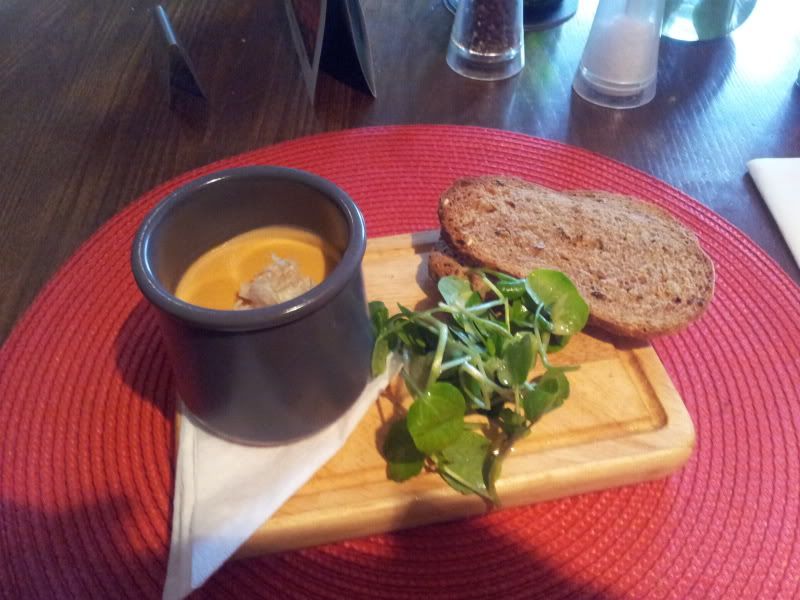
The starting pistol for this marathon was one of my favourites: Muncaster crab parfait with crispbreads.
Muncaster crab parfait, Parkers crisp breads
I have had this a few times before at the Parkers Arms. The presentation this time (in the little pot, as you can see) is new, and unfortunately this wasn't the best, as they'd sold out a lunchtime and quickly knocked up a new batch, and mine hadn't quite had long enough to set, and was a little too liquid. But the creamy richness and intense crab flavours were there in force, and it's much better to be a bit runny than overset. One thing that always impresses me at the Parkers Arms is that even a small garnish of watercress, such as came with the crab parfait, is nicely dressed. So many restaurants still omit to dress salad leaves.
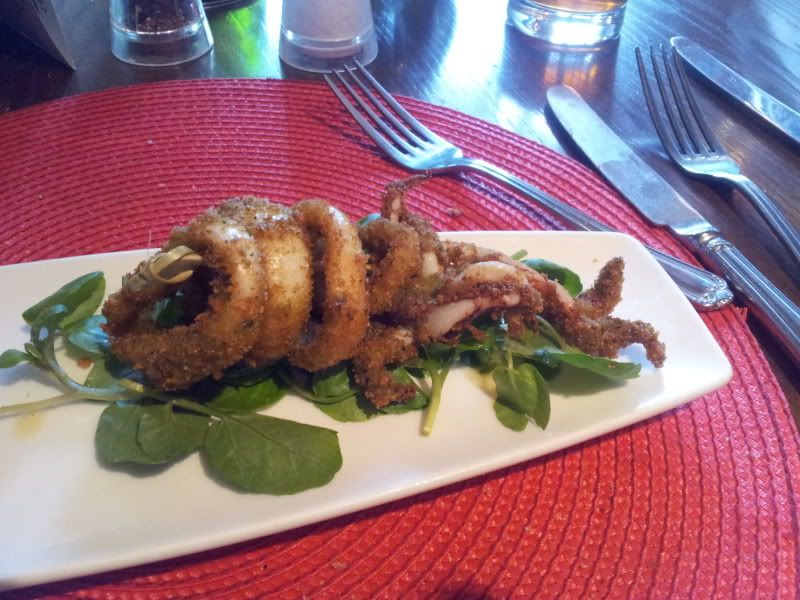
Next was a dish which had attracted me when I first saw the menu: herby crispy squid with sweet chilli sauce.
Herbed crispy squid, Parkers sweet chilli sauce
Little baby squid, in a light, remarkably herby crisp crumb. The squid was very tender, and the crumb at once light and crispy. The accompanying sweet chilli sauce was homemade and nicely balanced some fiery chillis with sweetness. But I wondered if it was really necessary, and whether some herb mayonnaise, or an aioli, might have matched the herby squid better.
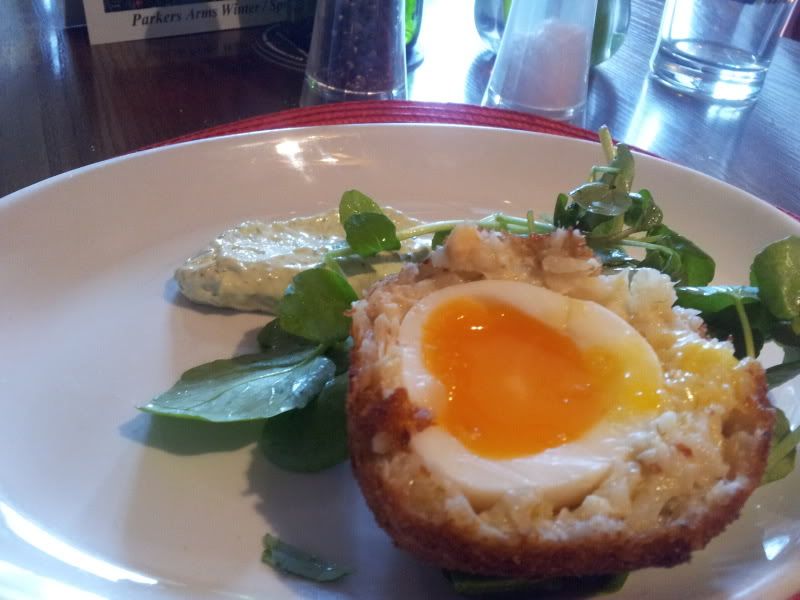
The next dish (the last of the starters) was Smoked Dunsop trout risotto and Slaidburn “Scotch egg” wild garlic mayonnaise. I was expecting some trout risotto, topped with a trout Scotch egg for textural contrast and dressed with the wild garlic mayonnaise. So it was a surprise to find that the first two elements were combined into what were effectively trout risotto arancini, with an egg in the middle.
Q: When is a scotch egg not a scotch egg? A: When it's a trout risotto arancino with an egg in the middle.
I'd hope that if I'd ordered this as a starter, that I would have been told it wasnt actually a risotto, as I could see that some might be a little disappointed if they were expecting a risotto. But I liked the re-working and the surprise, though I'm sure the surprise works better in a tasting menu format. But who could not be won over by that perfectly cooked egg? Just enough trout in the risotto to taste it and all accurately seasoned. The wild garlic mayonnaise would fly off the shelves if it were available to take away.
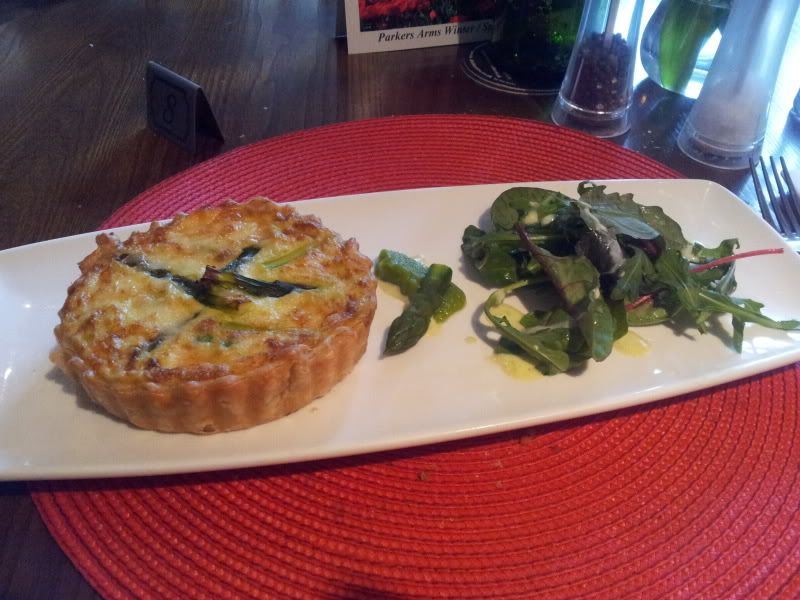
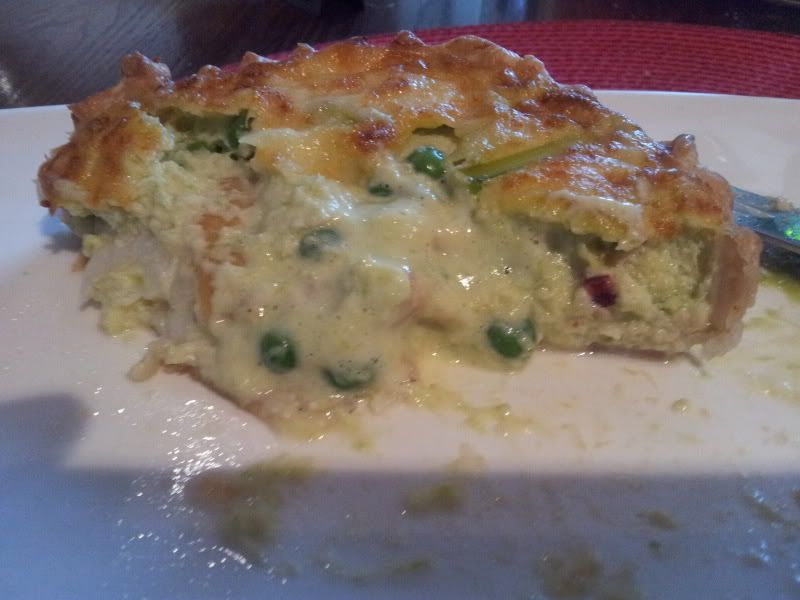
Our next dish was another play on the words of the menu description: "smoked haddock and Southport shrimp chowder and new season asparagus tart, tossed salad," said the menu. Would it be a bowl of chowder with a little asparagus tart on the side? Nope.
Smoked haddock and Southport shrimp chowder and new season asparagus tart, tossed salad
This was where culinary madness meets inspired genius. A beautiful 'chowder' topped with some asparagus, and cooked in a tart case with the sort of thin, crackly pastry you would usually only ever find in those lovely little Portuguese custard tarts, pasteis de nata. This was a triumph. The pastry was utterly delectable, and the filling was just gorgeous: very lightly set, with a baveuse centre, and no one element dominating the others. In London, this would have bloggers and the twittersphere going mad and long queues round the block.
Here's the money shot of the tart:
Flantastic
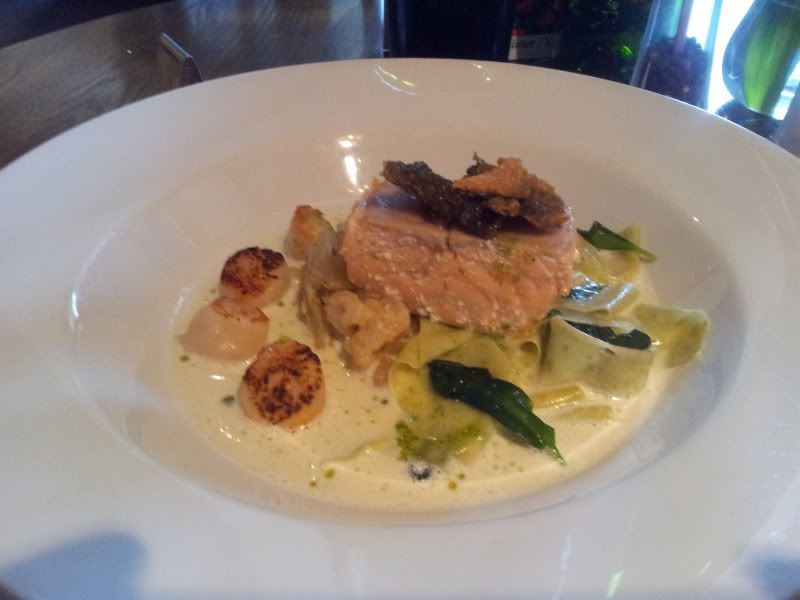
Next came something that was a little more straightforward, but no less accomplished in conception or execution. Some gently, perfectly cooked salmon was the centrepiece, but curiously could easily have been left off without making it any less of a dish.
Confit Loch Duart salmon, Isle of Man queen scallops and broth, braised fennel, wild garlic pappardelle
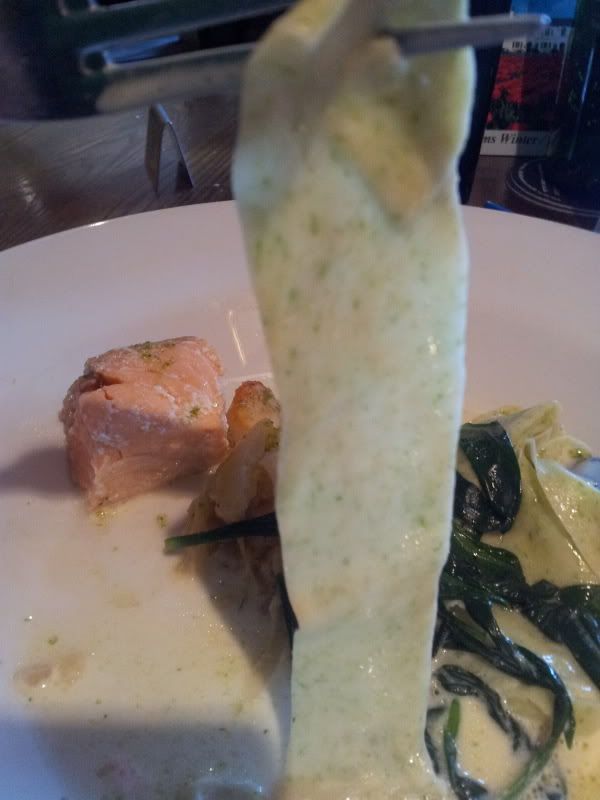
Alongside the salmon (which looks a little over-cooked in the picture for some reason: it wasn't), some excellent, neatly caramelised queenies, almost unctuous braised fennel and a truly delicious, delicate light cream were, for me, the supporting cast for the real star, some home-made wild garlic pappardelle that was as thin as gossamer silk, yet still had a subtle taste of ramsons.
Gossamer thin wild garlic pappardelle
If this is beginning to sound like it was a set of discrete yet delicious ingredients that just happened to be on a plate together, that wasn't the case: it all worked really well together.
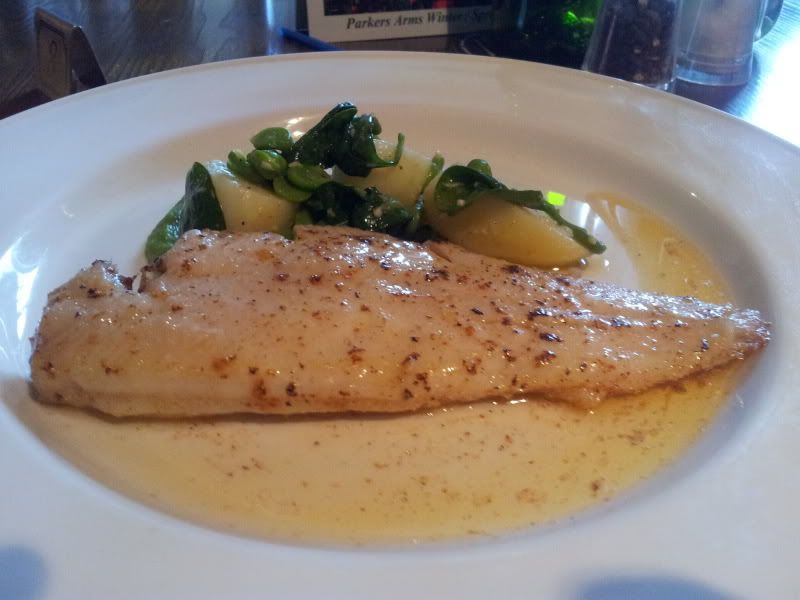
The final main course was a simple classic: lemon sole with beurre noisette.
A really simple preparation and presentation, with nowhere to hide. It was a small sole, yet remarkably plump. You couldn't criticise either the neatness of the preparation or the spot-on cooking of the fish. The beurre noisette was bang on too. Served with some simple new potatoes, spinach (fully shelled) broad beans and peas. Faultless. Better than the 3* baby sole starter that I had in the final days of Chez Nico on Park Lane: better fish to start with, and better cooked.
The first dessert to arrive was a very grown-up, adults-only chocolate and espresso trifle.
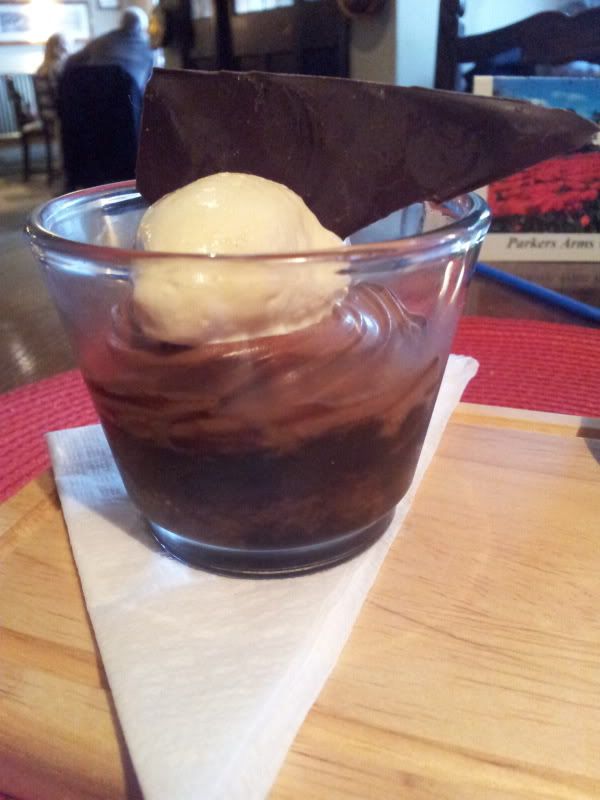
Dark Chocolate espresso and Kahlua trifle
It sounds heavy, and looks a bit heavy too, but surprised me by being much lighter than I'd expected, helped by really not being very sweet at all. It made me think of an inverted tiramisu, with the coffee and chocolate to the fore, and a little quenelle of chantilly cream, rather than the mascarpone mix that makes up the main element of tiramisu.
At this point, we waved the white flag, passing on the lemon posset with damson jelly and the cheese. Well, that was the intention. The cheese still came, and the posset was packaged up to take away!
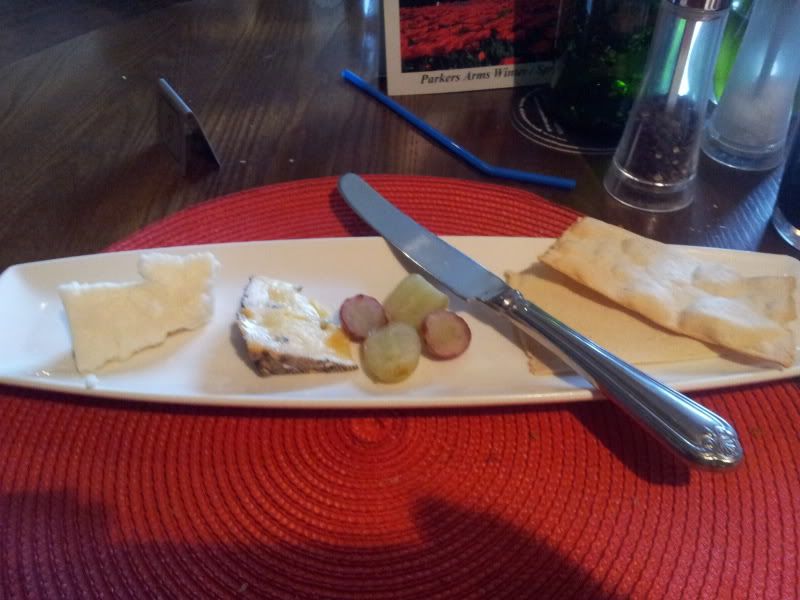
The cheese was in good nick, served with some iced grapes and homemade water-biscuits. Who makes their own water biscuits, you might well ask. They're quite different to any you might buy, and much tastier.
All in all a really good lunch which turned into dinner.
I have just re-discovered some notes scribbled on the train back from London in 2011 of a meal at Texture in London. So apologies for the brevity, but as this was a very enjoyable meal, I thought it still worthing posting a report here.
Aggi Sverrisson was born in Iceland, where he worked until he moved to England to join Gordon Ramsay's Petrus in 2001, where he was briefly a chef de partie under Marcus Wareing, before moving to Luxembourg in the same year. He didn't stop there long either, as he was back in England in 2002, working at Raymond Blanc's Le Manoir aux Quat' Saisons. Having risen to head chef at Le Manoir, he and Xavier Rousset, Le Manoir's sommelier, left to set up Texture on Portman Street, just off London's Oxford Street. (It's actually within and shares some facilities with the Mostyn Hotel - handy to know if your cab driver looks blankly at you: they just don't seem to keep up with the London restaurant scene these days...)
You climb a few steps from the street and enter a remarkably high-ceilinged room, with a large bar-cum-room divider separating the front champagne bar from the dining room proper. Right at the back the kitchen is semi-open to the restaurant. Although it's certainly a very grand dining room, I found it rather cold in atmosphere, something certainly not helped by the huge divider that is the bar, that saps the light out of the room. For that reason, I'm afraid there are no photographs of the dishes.
I went in just after 2pm on chance, and they were happy to accommodate me, and (to my surprise) even happy for me to order one of the tasting menus.
The meal started with various crisp things (including fish skin) with a yoghurt and barley dip. The dip seemed odd at first - completely novel - but really grew on me, until I decided it was absolutely delicious. Still odd, but delicious.
Bread was very good, with the butter served on pebbles (reminding me of L'Enclume).
The first dish was a mix of prawns (Icelandic of course), tomato snow, gazpacho and sun dried tomato. The star was the prawns, with the other ingredients really not managing to be more than bit part players.
Gravadlax came next. A generous chunk of salmon, which I thought gave a much better balance than the more usual slices. Though the salmon was quite soft-textured: I expected something firmer. The gravadlax was served with a variety of liquids, purées and an ice (including a very poised horseradish cream), which once the "snow" had started to melt, all rather flowed together into one pool, losing the integrity of the individual flavours.
The next course was roasted langoustine: a single, huge, perfect langoustine. The best ever langoustine I've had. It was served on a bed of quinoia, with a vegetable nage, baby daikon and some (I think) sea greenery. A good blend of sweet and earthy. An outstanding dish.
Some exemplary monkfish came next. Superb fish, beautifully cooked. Served with smoked leek, fresh leeks and a vibrant green leek sauce with a liberal sprinkling of tiny girolles. Excellent dish.
The first dessert was a sauternes sabayon with sorrel granita. Gorgeous. I also thought the light dusting of cinammon on the sabayon worked very well.
Finally came a white chocolate mousse and ice cream (the no butter, no cream philosophy of Sverrisson doesn't extend to desserts). Also on the plate was some dill and cucumber: a very odd combination, but one which really worked, producing a delicious dish.
Excellent coffee came with pretty good petits fours. Fisherman's Friend flavoured meringues were a little wimpy; some fairly non-descript chocolates; a lovely pistachio madeleine and a very good passion fruit macaroon.
An interesting wine list: I had half a carafe of 2009 Keller Riesling trocken QbA, which worked well with the food.
My bill came to a somewhat hefty £110, which I don't really begrudge, though it seems at the top end.
When I went looking for Yuzu, I managed to walk past it once without seeing it. It is on the edge of Manchester's Chinatown, on the corner of Faulkner Street and Charlotte Street (believe me, not Google Maps....). Compared to the gaudy fronts of many of the other businesses in Chinatown, Yuzu's street presence is distinctly muted.
The muted appearance seems to me pretty much Yuzu's hallmark. Everything from decor, to service, to food is understated, precise and decorous. There is a lot of bare, polished wood and plain walls, with the main decoration being empty sake bottles on the window sills and around the semi-open kitchen. A bebop jazz soundtrack plays quietly in the background.
While the specials menu (pictured above) is short in the extreme, the main menu, while still far from long, offers enough to make me think several return visits are in order. The bulk of the menu consists of sashimi, tempura and udon noodle dishes, the first two coming in various "don" formats. Don is apparently short for donburi and refers to meat, fish or vegetables served on a bowl of rice.
There is no sushi on the menu, which I assume is a nod to the fact that to become a sushi chef in Japan requires a long apprenticeship. Unlike other pseudo-Japanese restaurants in Manchester and elsewhere, they don't pretend to be able to do sushi, so there isn't any, although there is a number of dishes of sashimi served on the 'don' bowl of sushi rice, which if you want to think of it in this way, makes a rustic or DIY version of sushi.
I think the absence of sushi shows a very laudable focus and authenticity (and more than a hint of equally laudable pedantry), as I'm sure they could produce vastly superior sushi than that which is generally available in this country: their rice (very firmly described as only Japanese rice on the menu) is easily the equal of the best sushi rice I've had in this country.
Alongside the main menu, they do a bargain lunch offer, with a number of don dishes priced at just £5.95 (or £7.95 for the salmon versions) and one noodle dish, and including a bowl of home-made miso soup.
Gyoza
I started with some gyoza - home-made prawn dumplings. These were very impressive. I've read some criticism of the 'pasta', but I thought it was just right. Though the real star was the fresh, vibrant filling, with beautifully fresh prawns, the like of which I've certainly not had elsewhere in Chinatown. Sourcing of ingredients is clearly done well here.
The interior of the gyoza
The gyoza were so good on their own, that it seemed almost disrespectful to dip them in the really quite fiery soy-chilli dipping sauce. I settled on an eat half, dip half approach, and really couldn't work out which I preferred.
Organic Teriyaki Salmon Don
For main course, I chose the teriyaki organic salmon don from the lunch menu. As I've already mentioned, the rice was really good, perfectly seasoned. For those used to teriyaki meaning a heavy, thick, sweet glaze on meat or fish, here the teriyaki will come as a surprise, though I'm reliably informed that Yuzu's version is much more authentic. It is a very delicate glaze, more of a seasoning than a flavouring, that allowed the salmon to stay centre stage. This probably looks and sounds a very simple dish (rice, a bit of salmon and some spring onion), and indeed it is. But, as ever, in such simplicity there is nowhere to hide. Very delicate, elegant and poised with great balance.
Miso soup doesn't ever really do much for me, and had it not been included, I wouldn't have ordered it. But here again was a balanced, understated, savoury flavour, far removed from the stale dishwater that is sometimes passed off in pseudo-Japanese restaurants in this country.
Yuzu is not going to impress anyone who wants big, bold flavours, but I think its accomplished, authentic cooking must make it one of the best Japanese restaurants, certainly outside London. It's very focussed, and, although I can't say this authoritatively, it felt more like I imagine Japanese home cooking than you normally find.
Desserts are peremptory - bought-in Cheshire ice creams. No doubt very nice, but I didn't bother.
With a bottle of Kirin Ichiban beer, my bill for the above came to just £14.05, which I think is really exceptional value.