Whenever a new Michelin guide is due, there always seems to be a flurry of interest among "foodies", restaurateurs and chefs, and it's easy to assume that this is a reflection of the modern obsession with all things food. But that fascination and speculation has been around for years.
Recently Michelin UK added to their website a couple of articles reproduced from the Telegraph Magazine of 15th March 1974.
Someone at
Michelin must have been rummaging through their archives and found a
copy of The Telegraph colour supplement from 1974 introducing its
readers to the idea of Michelin's red guide and making some predictions
as to which restaurants might get stars.
I find them really
rather fascinating, as a historical document in themselves, as a testament
to how much things have changed, and yet also how so little has changed.
In the first article, I was particularly amused by Prue Leith quoted as saying "You have to be pretty awful not to get into The Good Food Guide" and rather perplexed as to why it refers to Albert Roux throughout as André Roux.
I
remember the Stevensons' (no relation) Horn Of Plenty at Gulworthy, and Patrick Stevenson one night intoning that anyone who
didn't like opera and model railways should have been put down at birth.
The
interview with Michelin in the second article almost reads just like
any interview with Michelin you ever read, save, maybe, for the
occasional condescending dig at English cooking.
I thought it might be interesting to look at the Telegraph's predictions and see how accurate they were. Very, as it turns out.
"Our experts consider it unlikely that any British establishment will be found deserving of two stars, let alone three." Well, their experts were certainly right about that.
"As to numbers of one-star restaurants, our experts think it unlikely that they will number fewer than a dozen or more than 20." Ah well, close: there were 22 stars awarded to UK restaurants in the 1974 Red Guide.
These are the restaurants they predicted would get one Michelin star when the 1974 red guide came out:
The Connaught Hotel ("the restaurant, not the grill room") - one star from 1974-1976, 2 from 1977-1981, then back down to 1 again.
Thornbury Castle - one star from 1974-1982
Le Gavroche - one star 1974-1976, 2 stars 1977-1981, 3 stars 1982-1991, then 2 stars again
La Toque Blanche - one star from 1974-76
Waterside Inn - 1 star from 1974-76, 2 from 1975-84, 3 stars from 1985.
Le Poulbot - one star 1974-79
Bell Inn, Aston Clinton - one star in 1974 which it lost in 1975 before regaining for 1976-79.
The Box Tree - 1 star from 1974-77, 2 stars 1978-1987
Horn of Plenty - 1 star from 1974-1983
Hintlesham Hall - 1 star from 1974-1982
Le Bressan - 1 star 1974-79
Wilton's - Had to wait till 1975 for a star, presumably when they deigned to return Michelin's questionnaire
The only two of those I'd not heard of were La Toque Blanche and Le Bressan, both in London.
These are the one-stars in 1974 that the Telegraph's experts didn't predict:
Hole in the Wall, Bath
Randalls, Brixham
Duck Inn, Canterbury
The French Restaurant, Midland Hotel, Manchester
Hotel de la Poste, Swavesey
Malmaison, Glasgow (the old BTH one, not the newer Michael Caines one!)
Carrier's, Islington
Le Coq Hardi, Kensington
Lee Ho Fook, Soho
Simpsons in the Strand
I had no idea there was a Chinese restaurant with a Michelin star in 1974!
You can see the full history of Michelin stars 1974-2015 for London here and for the rest of the United Kingdom here.
Hambleton Hall is a very fine country house hotel on the shore of Rutland Water near Oakham. I have been occasionally over the thirty odd years since Tim Hart opened it. The number of visits have been restricted both by its distance from my usual stamping grounds and the fact that it comes with a price tag to match the luxury setting, at least if you want to stay over: if you're in the area, they have some good value lunch deals.
My last visit to Hambleton Hall was in 2009 when I joined a group of friends in a private dining room for an evening looking at wines from the 1989 vintage. At such events, the food often takes second place, but the quality and finesse of the food and its cooking kept it very much in the foreground. So when I learned I was going to be treated (not by anyone related to the hotel, I hasten to add - everything was paid for) to a couple of nights at Hambleton Hall earlier this year, it was certainly something to look forward to.
The hotel side is as you would expect: everything is in elegant order, staff manage to appear as if by magic whenever you need something, fires are lit, cushions are plumped. But it's more of a comfortable place, than a grand place. Outside there are a croquet lawn, a small swimming pool, well kept gardens and, I think, a tennis court. You could easily imagine a Noël Coward play or a Poirot novel set here.
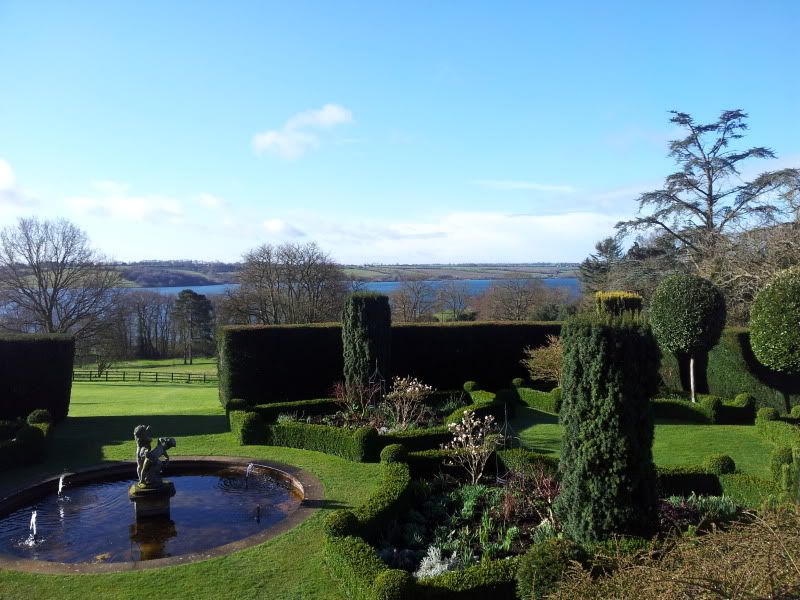
The view over the garden to Rutland Water
Our bedrooms had the sloping ceilings of the eaves, such that in my room at least there was no way you could take a shower as there wasn't room to stand upright in the bath, which in real luxury style seemed big enough to hold half of Rutland Water: a bath designed for long soaks and total immersion. Bliss. Though it's worth noting that my room was a "standard" room up the back stairs (you could almost see where, on the ground floor corridor, the green baize door would have been): the bedrooms in the "family" half of the house may be grander. Beds have the really high quality sheets you would expect. Housekeeping is of the highest order.
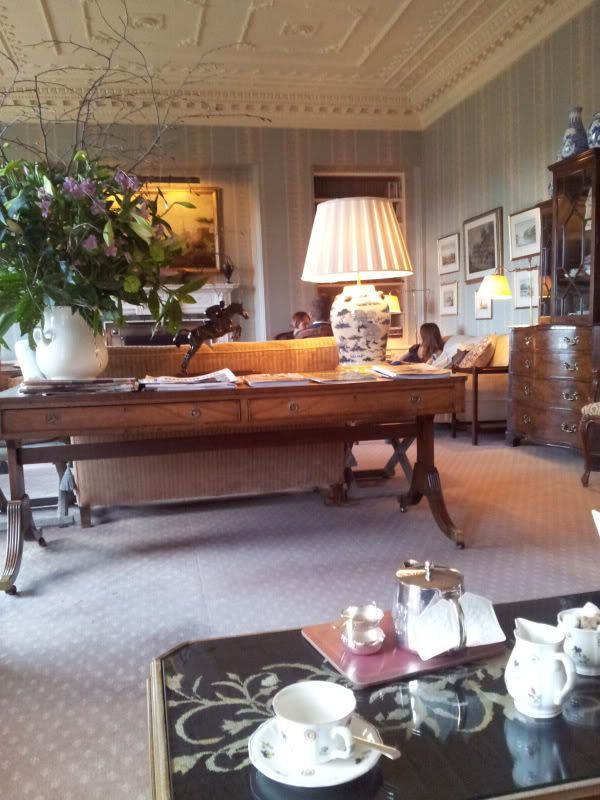
Downstairs there is just one lounge, plus some seating in the entrance hall and a relatively cosy bar. The lounge tends a little too much to hushed conversation and I felt that the bar was more relaxing.
The lounge
Hambleton Hall has held a Michelin star since 1982 and the kitchens have been under the control of head chef Aaron Patterson since 1992 (I actually ate there in his first week as head chef!). The restaurant is classically and formally decorated with decent sized, well-spaced tables, with all the quality napery, cutlery and crockery you'd expect. Service is excellent, if formal. Lighting is a little subdued, so apologies to both readers and Aaron Patterson for the less than perfect photographs. Aaron Patterson's food fits well in this setting: there's a solid classical foundation with a few modern twists. We ate over two nights and our overall impression was of a little inconsistency, with some dishes being truly excellent, while others just fell a little short.
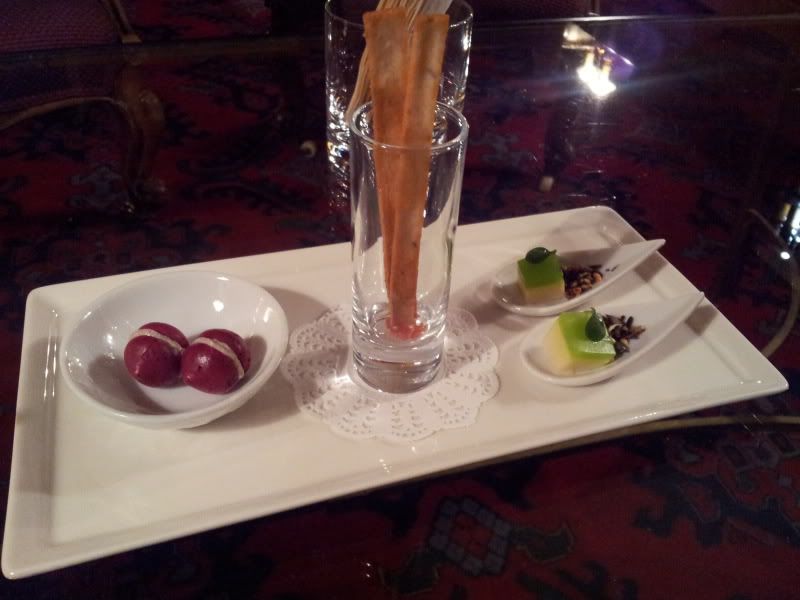
Dinner starts with drinks in the lounge or the bar, with canapés. On the first night, the canapés were a "fig bubble" topped with a little shaved ham, deep-fried goujons of bream with a saffron mayonnaise and some delightful gougères. On the second night, the real standout of the three canapés were the little beetroot macarons.
Canapés (day 1)
Canapés (day 2)
As well as a £75 5/6 course tasting menu, there's a three course à la carte for £65, with a separate "gourmet corner" of a starter, main and dessert with supplements. There's also an absolutely fabulous wine list with prices that really aren't that gouge-y, especially for the class of establishment. We had a delicious, maturing 2008 Le Soula and an equally excellent JJ Prüm Wehlener Sonnenuhr Kabinett from 2009.
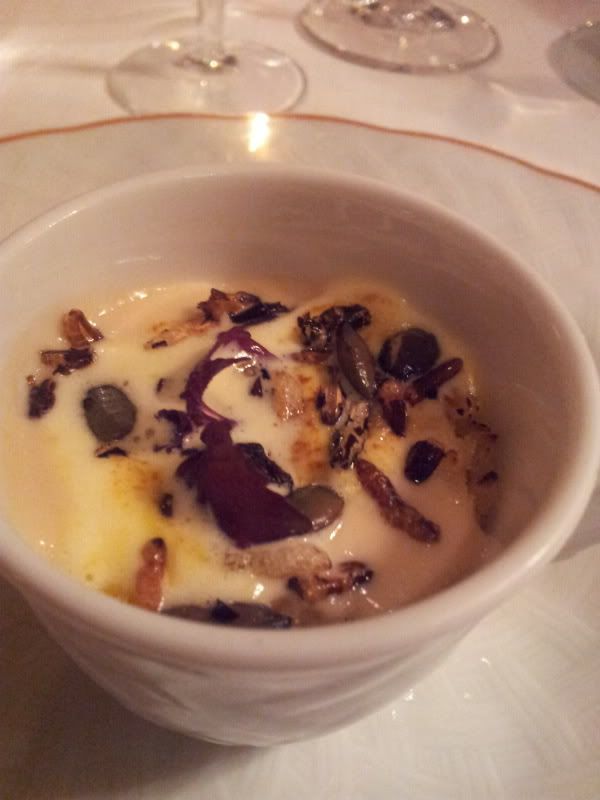
Once at the table, the meal starts with a demitasse of good but ultimately forgettable soup - forgettable in the sense that while I remember it was French onion soup one night and both had some good texture, I've completely forgotten what the other was.
Amuse bouche
A bouillabaisse terrine was excellent. It looked picture perfect, had great flavours, reminiscent of a bouillabaisse, but with a much more elevated set of prime ingredients: lobster, tuna and hake, all of which were cooked perfectly. Really extremely impressive.
Bouillabaisse Terrine with a saffron dressing
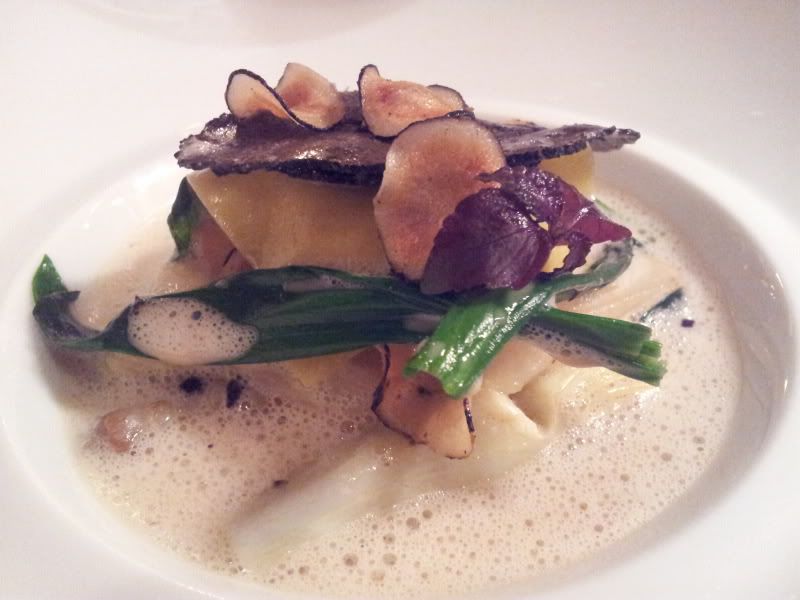
Similarly, a lasagne of of black Perigord truffle, combining truffle, artichokes and a perfect chicken mousse, was a stunning starter and there were no regrets about the £6.50 supplement.
Lasagne of Black Perigord Truffle
Another excellent starter came from the tasting menu. No eyebrow was raised or anything when we asked if we could have the red mullet with blood orange and almond, a dish which appeared only on the tasting menu. Really excellent fish, perfectly cooked, and I adored the orange and almond accompaniments which almost lent it a slightly Moorish feel.
A fillet of beef was decent enough, nicely cooked as requested and served with slow cooked Jacob's ladder and watercress and wasabi purée. But as a dish, it felt much safer and lacked impact both visually and on the palate. The wasabi in particular was much more muted than it needed to be.
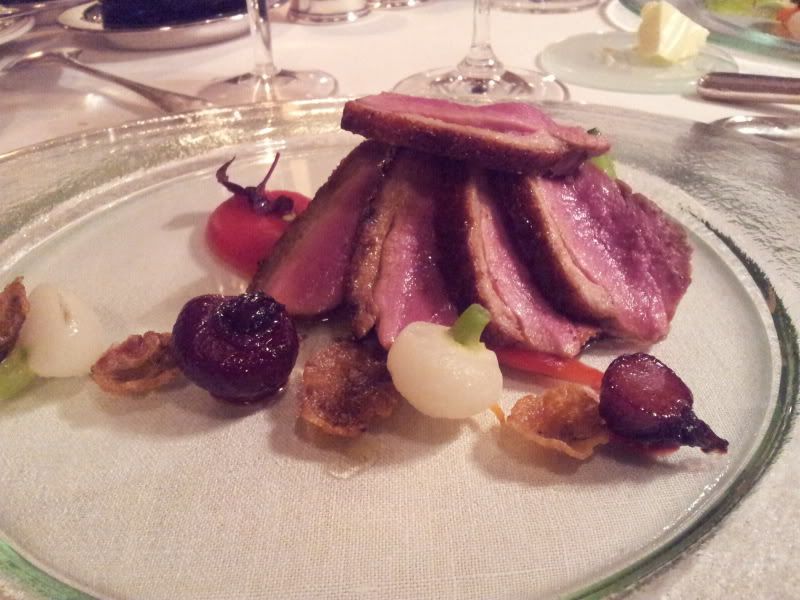
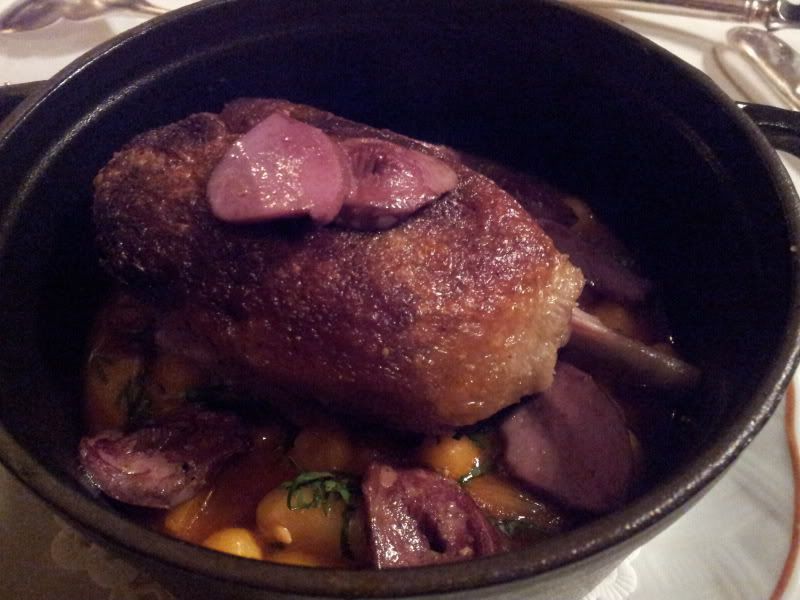
A roast duck breast was again perfectly cooked: beautifully tender and a good flavour, served with tamarillo that worked well with the duck. A cassoulet of duck, apparently flavoured with fresh turmeric, was served separately. The confit duck leg was excellent, and it was great to see the duck heart so prominent. But the cassoulet itself was a let down: I found the beans just too undercooked, to the point that I asked for it to be taken back to the kitchen so that the chef could check it was how he expected it. The answer came back that that was how Aaron Patterson wanted to serve the beans. Fair enough. I didn't like it though: the not-quite-crunch of the beans was not a texture I appreciated and, it seemed to me, detracted from what should be a quintessentially comforting dish.
Roast Great Dalby duck with tamarillo purée
Duck cassoulet flavoured with fresh turmeric
Fortunately an Assiette of Rabbit restored our faith in Aaron Patterson's abilities. This really was a stunning, complex dish, with a sauce lightly favoured with licorice, that also made the Prüm riesling really sing in my view. The loin was wrapped in (I think) a light rabbit mousse; the rack roasted with a herb crumb; a rich, braised leg, served with a pearly barley risotto and that excellent licorice sauce. Really beautiful dish, showing off the kitchen's skills. Perfectly seasoned in all elements too.
Assiette of rabbit with pearl barley risotto & liquorice flavoured sauce
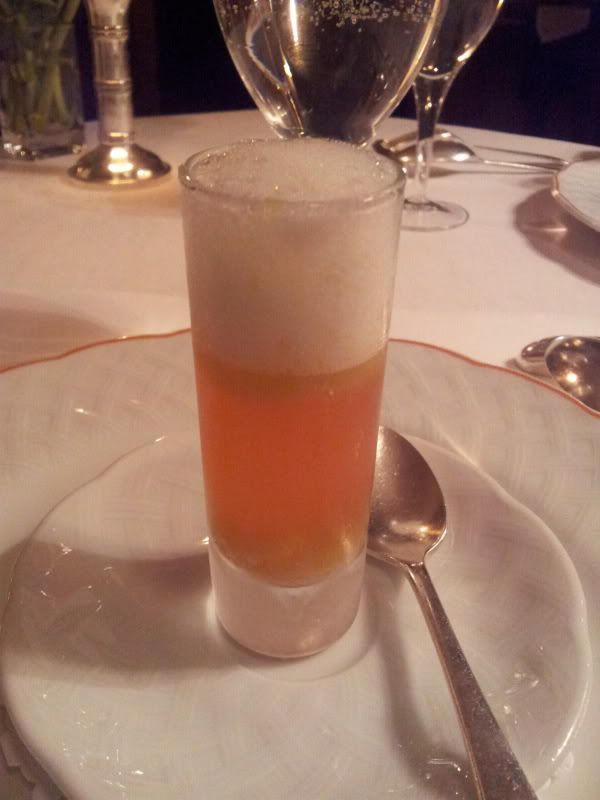
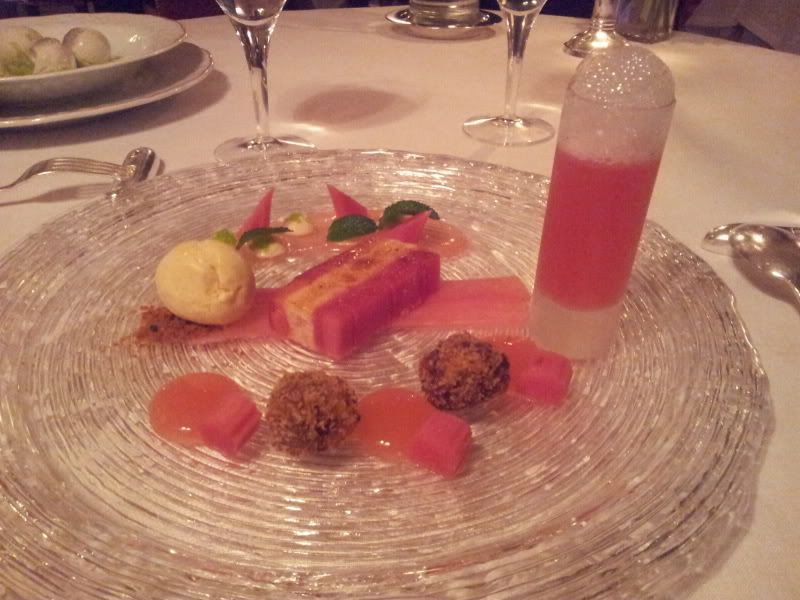
A pre-dessert of a sort of granita comes in a shot glass. Fennel, orange and rhubarb one night; "taste of mojito" the next. Refreshing, and just a taste. For me the fennel, orange and rhubarb was very much the superior.
Fennel, orange and rhubarb pre-dessert
"Taste of Mojito" pre-dessert
Those shot glasses quickly reappear with dessert proper. The three desserts we had were all fine, with lots of technique, but if there were one area where Hambleton Hall might look to improve the menus, I would respectfully suggest that it would be desserts. There was nothing wrong with any of them, but (with the exception of the Brillat-Savarin tart) there just seemed to be a little too much effort and too much technique which rather minimised the impact of the named main ingredients. The other way to look at it is, I suppose, that the pastry section likes doing very refined desserts. This was particularly the case with a dish of "Tastes of Lemon & Violet" which just seemed to miss the point somehow. Terrine of Rhubarb was better, but for me there was just a bit too much going on on the plate, to the point that it was the lime leaf ice cream that really stood out for me.
Terrine of Rhubarb with lime leaf flavoured ice cream
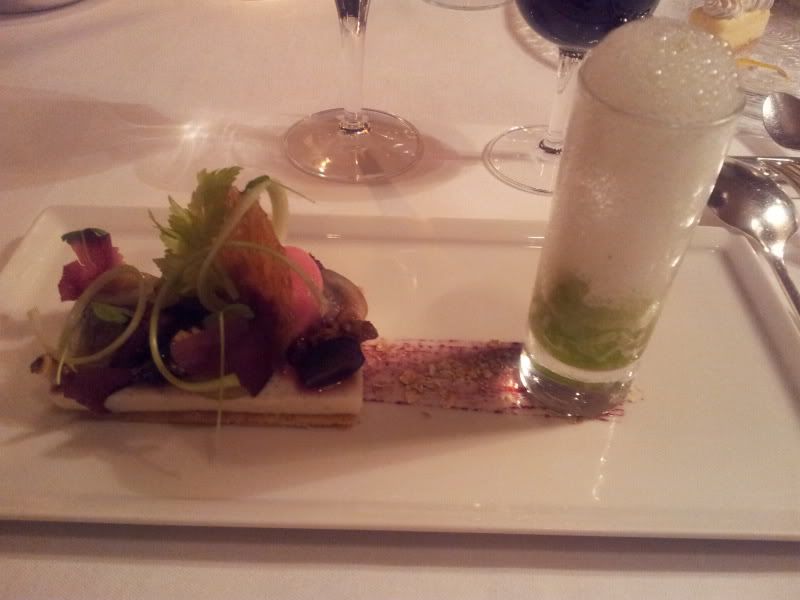
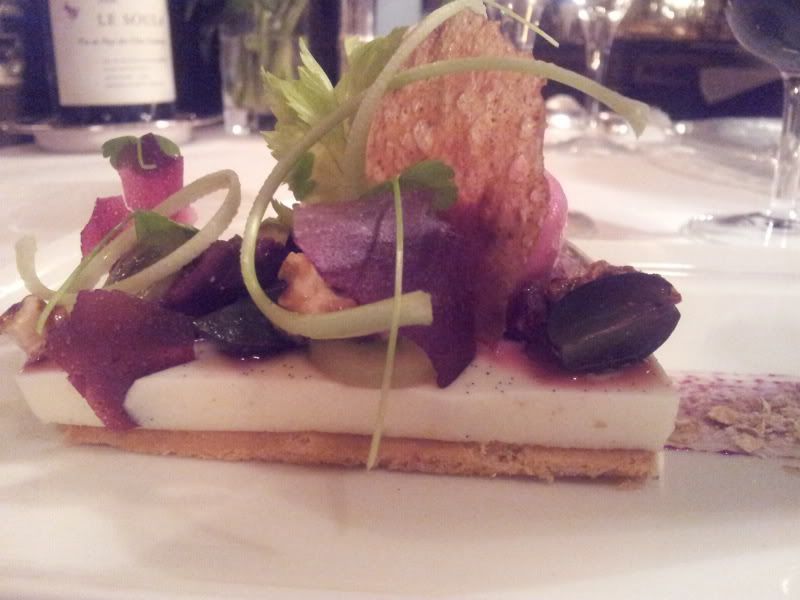
A Brillat-Savarin tart seemed to be in a different league: clean, and focused. A nice idea well executed, though even here the shot glass had to reappear (was it a celery granita & foam??).
Brillat-Savarin Tart with figs, walnuts & grapes
Detail of the Brillat-Savarin tart
Breakfasts were very good, though curiously more generous on the second day. The breads were excellent, as you would expect given that the brilliant Hambleton Bakery is in the same ownership. The small muffins in particular merit particular mention (I bought lots from the Bakery to stock my freezer), and played no small part in having some jolly good Eggs Benedict on the second day.
We enjoyed some excellent food at Hambleton Hall, as you would hope. It is after all, what one beer company once called reassuringly expensive. If you choose well, it's no doubt not merely worth it, but also good value, especially as portion size is far from skimpy. If that excellence could be transferred to all dishes, then Michelin's one star would start to seem a bit mean.
I always think hard about these guest chef nights at restaurants. The guest chef is working in a strange kitchen, with a bunch of cooks s/he's probably never met before, let alone worked with, and quite often with the host's suppliers not their own.
From the customer's point of view, you might be getting the guest chef's recipes, but you're in the dining room, which isn't the guest chef's dining room, the staff aren't theirs, neither is the wine list, coffee machine etc. My point is, you're not getting the experience of going to the 'other' restaurant. So, for me, the guest chef has to be sufficiently far away that it would be a real trouble (and expense, because these nights are never cheap) to get to. Either that, or some element of competition or fun/theme that attracts me.
Little Bedwyn, between Marlborough and Newbury, is well over 200 miles from me, so a night at the Freemasons at Wiswell certainly wins on that score. It's still not the same as going to the Harrow at Little Bedwyn though. But a lot easier.
Roger Jones has held a Michelin star at The Harrow since 2007. But since Paul Heathcote hung up his apron, Michelin hasn't been able to draw its attention away from Northcote and the Box Tree, and they seem to be very reluctant to recognise the achievement of anywhere inbetween. Other guides largely follow suit. Certainly the Freemasons at Wiswell must be edging close to a star, but for this one night there was one star in residence.
One glance at the menu and I tried to tweet a picture saying, "Yes, that is going to do very nicely." But the signal in Wiswell is too bad to do that.
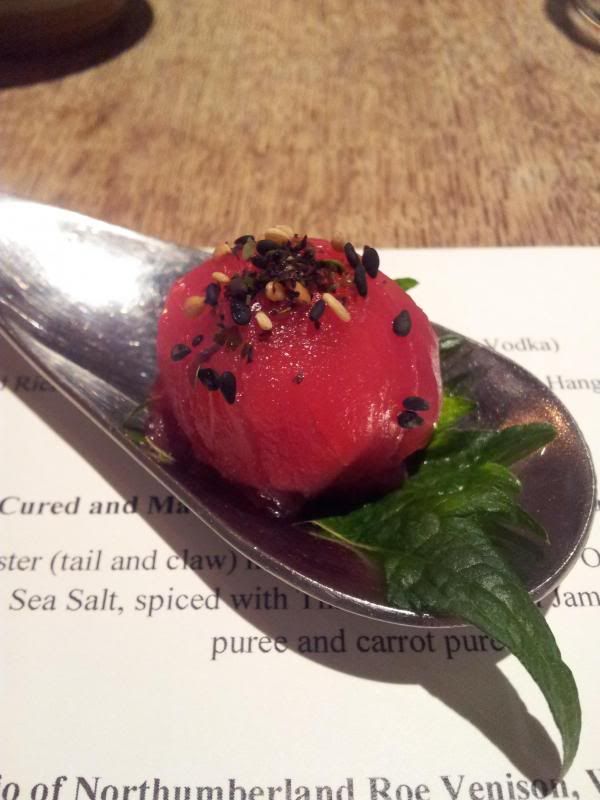
But before that, there were a couple of canapés to deal with. First came a ball of tuna sashimi filled with a wasabi-flavoured cream cheese on a shiso leaf. For me, I thought it was marginally too big, and could have coped with a little less of the filling: it was quite difficult to bite in two elegantly, but too big to pop in the mouth whole. The filling was, however, jolly good: like Boursin that's been on its holidays to Japan and wishes it hadn't come back. Not sure if this was Roger Jones' canapé, or whether host, Steve Smith had done both canapés.
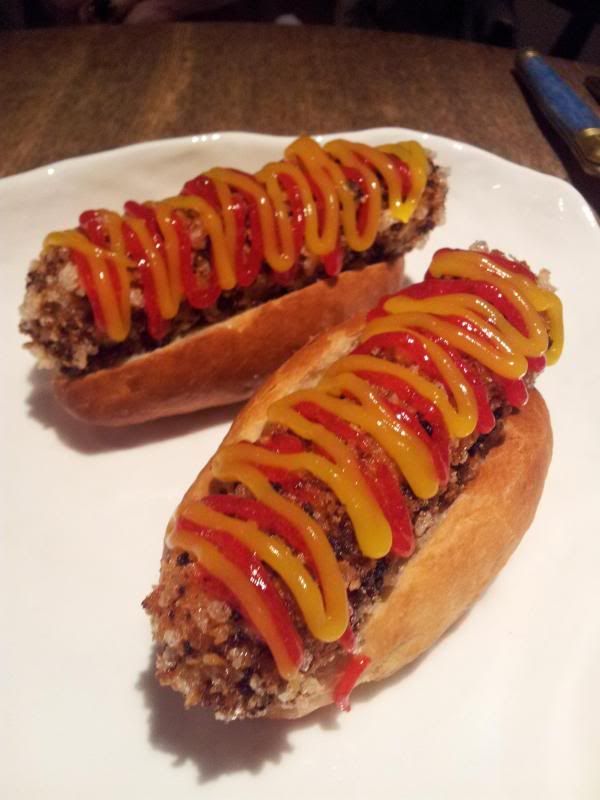
The second canapé was one of Steve Smith's: a foie gras hot dog. I've had this before, though as an accompaniment to soup. This is a foie gras enriched boudin blanc which has been breadcrumbed and then fried, before being presented in a mini brioche bun. Personally, I'd quite like to try these without the crumb and less pungent ball-game ketchup and mustard. Now I've written that, I can't get the idea of a truffle mayonnaise and a roast chicken fluid gel out of my mind over an un-crumbed foie gras hot dog. Consider the challenge laid down, Mr Smith.
Steve Smith's foie gras hot dog
We then moved on to Roger Jones' menu proper, starting with a shot glass of Bull Shot - this was a really rich, deeply flavoured, jellied game stock spiked with vodka. I've had these Bull Shots before occasionally, but this one was distinguished by the really superb game consommé and just enough vodka that you could notice it, but not the alcohol. And if that wasn't enough, the shot glass was topped with an excellent little biscuit.
Bull Shot
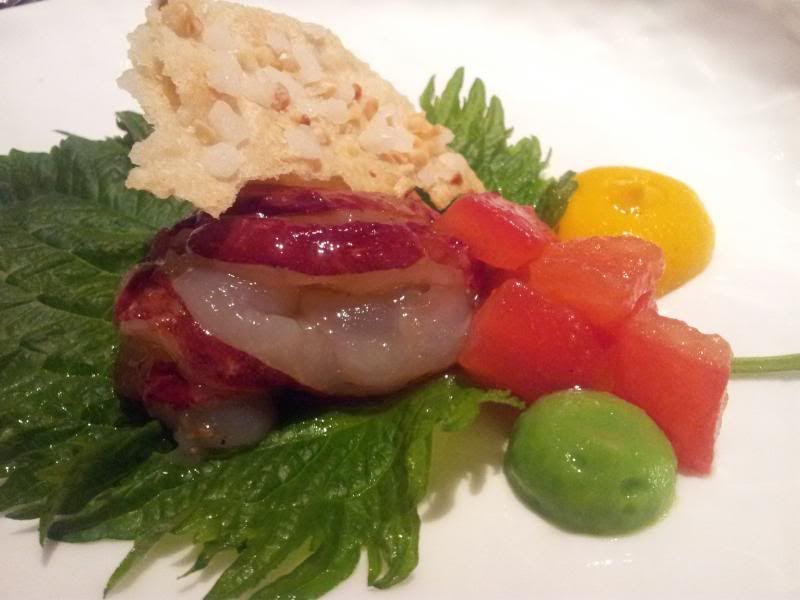
This was followed by Cured and Marinated Pembroke Lobster, Asian Spices. The lobster tail had been marinated in extra virgin olive oil and spiced Halen Mon sea salt, apparently spiced with Thai Lobster Chilli Jam (which I couldn't really detect). It was presented on a large shiso leaf (which really added something), together with a rather interesting salted wafer-biscuit-cracker thing, some diced tomato and little blobs of pea purée and of carrot purée. I didn't think the two purées really added much: if anything they took away from the freshness and brightness of the rest of the dish. But the lobster was really terrific: a beautifully balanced set of subtle flavours. For some reason it had never occurred to me reading the menu that the lobster would be merely only very lightly cured, so it was almost like a sashimi of lobster. What you can't see in the photograph (it's behind the cracker) is that each plate had a perfectly prepared slice of the claw: the central cartilage had been neatly removed and then presumably the claw was reformed before being sliced vertically. A terrific dish.
Cured and marinated Pembroke Lobster, Asian Spices
It was at this point that I re-read the menu and realised that Roger Jones had been really rather clever with the menu. The bulk of the menu could have been prepared in the kitchen at the Harrow in Little Bedwyn, entirely within Roger Jones' control, and brought up with him in the boot of the car. The amount of preparation needed from Steve Smith's brigade at Wiswell may well have been minimal, as indeed was the cooking required on the evening - which probably explained why the evening ran more smoothly, with fewer longeurs than is often the case with similar evenings elsewhere.
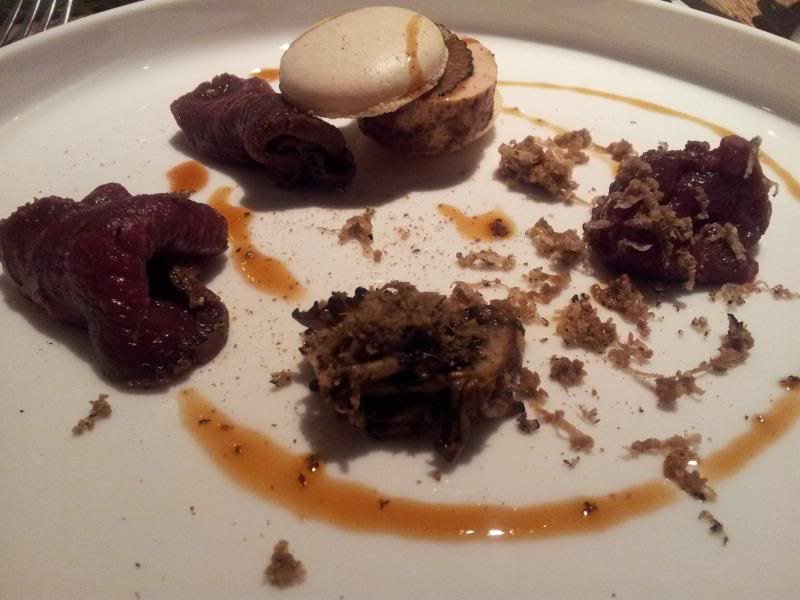
The next dish was Carpaccio of Northumberland Roe Venison, Wiltshire Truffles, Foie Gras Macaroon, Salted Caramel. Another really terrific dish.
Very good venison, sliced thick enough to be able to really taste it, but thin enough that it felt sexily silky in the mouth. There was just a hint of something beyond the venison (identified on the menu as spices, truffle and cep dust), which would probably have been more noticeable by its absence than immediately identifiable by its presence.
A slice of a small torchon of foie gras was the filling in a salted caramel macaroon, which initially seemed to be more of a counterpoint than an accompaniment. But when combined with the reduced PX sherry dressing and the fresh (and massive) Wiltshire truffle that was liberally grated over half the plate at the table, it was really tied into the dish as a whole. The menu also mentioned crisps, but neither of us could find anything on the plate that could be called crisps.
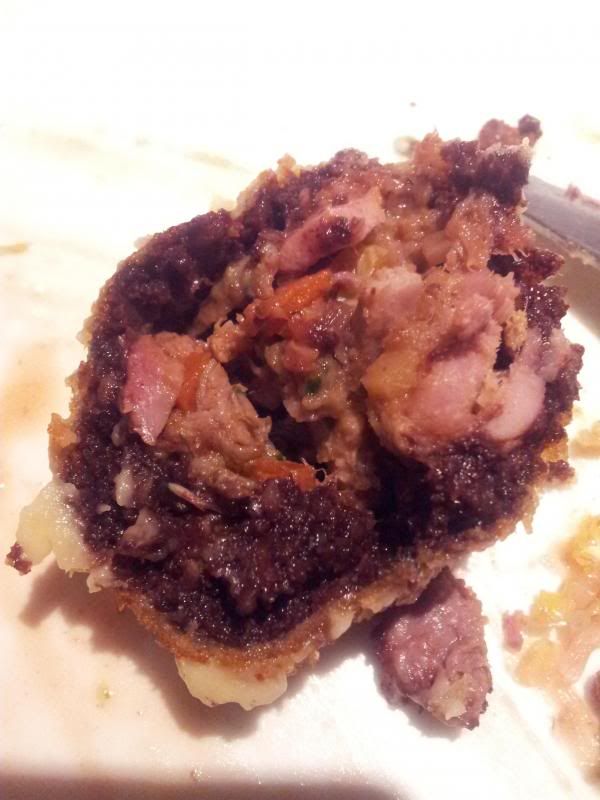
The final savoury dish was grouse: Breast of Young Grouse, Bon Bon, Parsnip Puree, Dates. Without a doubt (and leaving aside proper whole roast grouse with the traditional trimmings) this is the finest grouse dish of the last couple of years. The breast was beautifully cooked and had a good flavour, without being excessively gamey. The grouse bon bon was almost worth the trip on its own: a really good combination of grouse, black pudding, foie gras, chorizo and raisins. A slightly odd combination maybe, and it would be easy to sigh at the use of the now ubiquitous chorizo, but there's no doubt it that really worked. I could have eaten lots of these grouse bons bons.
When we initially read through the menu, we also wondered what on earth was the point of adding dates to parsnip purée. But by golly, it's good and I'll certainly be trying that one myself. Though it did rather underline Roger Jones' apparent love of having something a bit sweet on most dishes.
Breast of Young Grouse, Bon Bon, Parsnip Puree, Dates
The interior of the foie gras bon bon
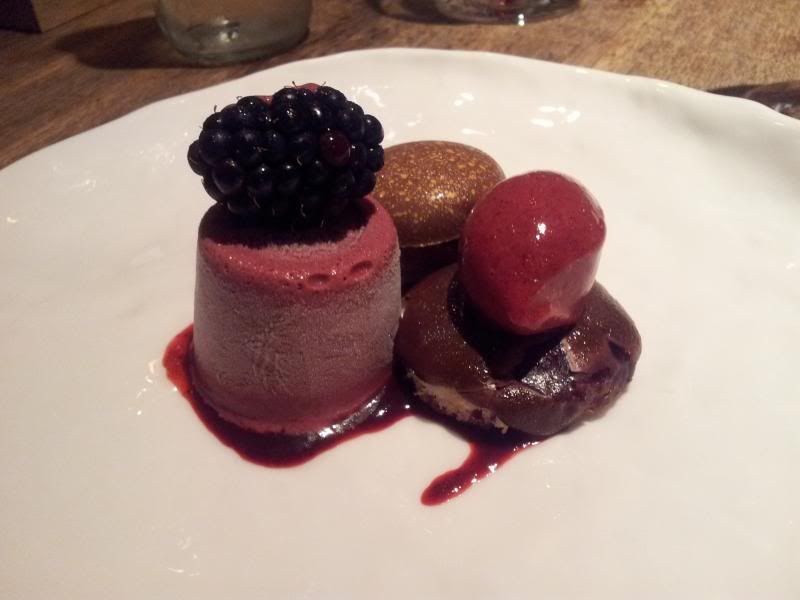
Dessert was a plate of blackberry things: blackberry parfait, a blackberry jaffa cake, a blackberry and champagne chocolate truffle and a distinctly moreish blackberry sorbet. All the elements were spot on. The chocolate truffle (in the background on the photograph) was momentarily challenging as everyone worked out how to eat it (cue the sound of a lot of spoons crashing onto the plates across the restaurant as everyone tried to cut it vertically), but once you went in horizontally, you found a remarkably thin, well-tempered chocolate shell filled with a ganache that tasted of what it was meant to. Even if it perhaps wasn't the most visually appealing element, he blackberry jaffa cake seemed rather inspired to me: clearly a jaffa cake, adding a bit of weight to the dessert with its sponge. A very nicely balanced dessert.
Blackberry
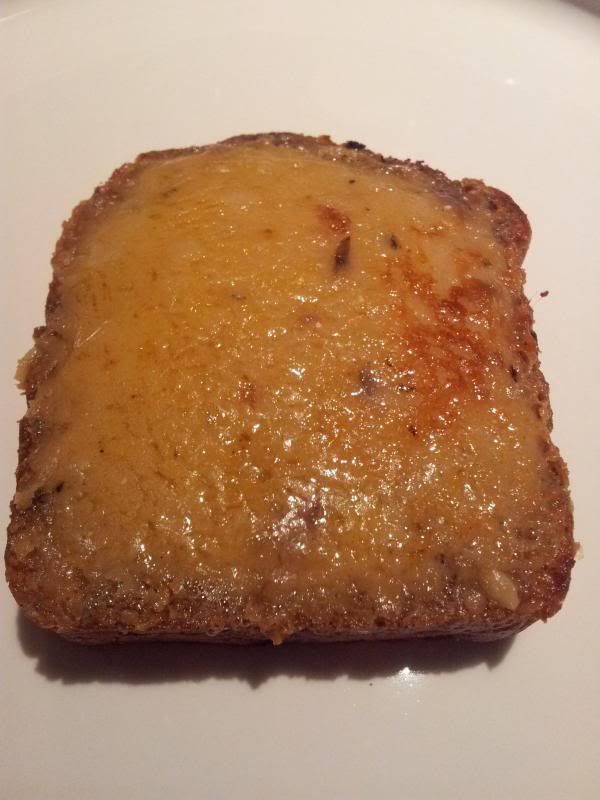
We had started with a 1970s hangover cure, the Bullshot, and finished on something remarkably similar. Resurrecting the now pretty much disappeared tradition of the end of meal savoury, with that classic, the Welsh Rarebit. Remarkably, this wasn't the first Michelin-starred Welsh Rarebit I've had, though this deserved its rating far more than the other (at the Pipe & Glass in Yorkshire). It's a bit boring to say it again, but this was quite possibly the finest Welsh Rarebit I've ever had. Probably the most remarkable thing about it was how light it was, as well as the very finely judged balance of flavours.
According to the menu there are three different Welsh and English cheeses in it, along with fish (which we identified as anchovy), tamarind, ale and spices. All served on beer and truffle toast.
Welsh Rarebit
As we were both driving, we shared one of the matching wine packages. Somewhat unfortunately, the wines were selected from the Freemasons list, not the utterly stupendous wine list of the Harrow at Little Bedwyn, which I've just spent an hour reading, or rather lusting over online. But the sommelier at the Freemasons had done a good job for the most part.
A very nice, 2011 The Opportunist Sauvignon-Riesling blend was a beautiful wine, excellent with the lobster.
2011 Sherwood Pinot Noir from New Zealand's Waipara Valley was not a wine to my taste, tooth-achingly young, and reminding me of Vimto-flavoured boiled sweets with added sherbert. It did not, we thought, go particularly well with the venison either.
2009 Painted Wolf Madach from Stellenbosch (a pinotage dominant blend with grenache, syrah, mourvedre and a bit of merlot) was also far too young really, but was a very good wine that worked extremely well with the grouse dish.
The All Saints Rutherglen Muscat served with the blackberry dessert avoided being cloying with some good acidity, and I thought the coffee and berry flavours worked well with the dessert.
A champagne flute of Wiswell Brew (a light session ale) was fine with the Welsh Rarebit, but felt a bit of a cop out, as surely there must be something on the Freemasons wine list that would have worked without risking mixing grain and grape. I'm thinking of a nice palo cortado.
This 18th century farmhouse on the main road into Ilkley has been The Box Tree since 1962 when Malcolm Reid and Colin Long (often known simply as "the boys") opened what came to be one of the most important restaurants in the north of England, earning one Michelin star when Michelin re-started publication of its UK guide in 1974, and holding two stars from 1977 to 1986.
It went into a bit of a decline after Messrs Reid and Long moved on in 1986, though it kept one Michelin star until 1991. It was then bought and pretty much resurrected by the formidable Madame Avis in 1992. The Box Tree regained its Michelin star under Madame Avis' ownership in 1996, and held on to it until 2002, when she lost interest largely as a result of her husband being diagnosed with a terminal illness. She leased (and subsequently sold) the Box Tree to the current owners, Simon and Rena Gueller in 2004, who regained the Michelin star in 2005, which it has held ever since.
I vaguely remember the Box Tree when the boys had it, and it's still very much recognisable as their restaurant, though fortunately the uncomfortable chairs seem to have gone: whenever we came across uncomfortable chairs, they were always said in our family to be "in the running for the Box Tree prize." Little changed under Madame Avis, though it did start to feel increasingly dowdy and in parts in need of a deep clean.
We recently returned to the Box Tree after a couple of years absence, and were completely baffled as to why we don't go more often. The food was, throughout, completely faultless and simply a joy. Fairly classical, but light dishes, well-conceived and perfectly executed.
We started in the dark bar-lounge area with some canapés which, on the face of it, didn't look terribly inspiring: some thin crisp flatbreads and two bowls, one of a salmon mousse and the other of, I think, a red pepper mousse. We were immediately struck by how well seasoned the mousses, particularly the salmon one were. A very minor criticism might be that the flatbreads were a bit too thin and crisp for dipping into the mousses, as, without care, they tended to break under the weight.
The lounge/bar area
In contrast to the bar area, the two dining rooms are fresh, bright, smart rooms, with good art and quality knick knacks such as large Herend animals. The butterflies painting, much coveted by Marco Pierre White, is however gone. Despite the closeness to the busy road, the dining rooms are well insulated from traffic noise. Tables are classically set with pressed white cloths and good cutlery and glassware.
Immediately bread and butter show respectively the emphasis on flavour backed up by technique, and an attention to detail.
Excellent bread.
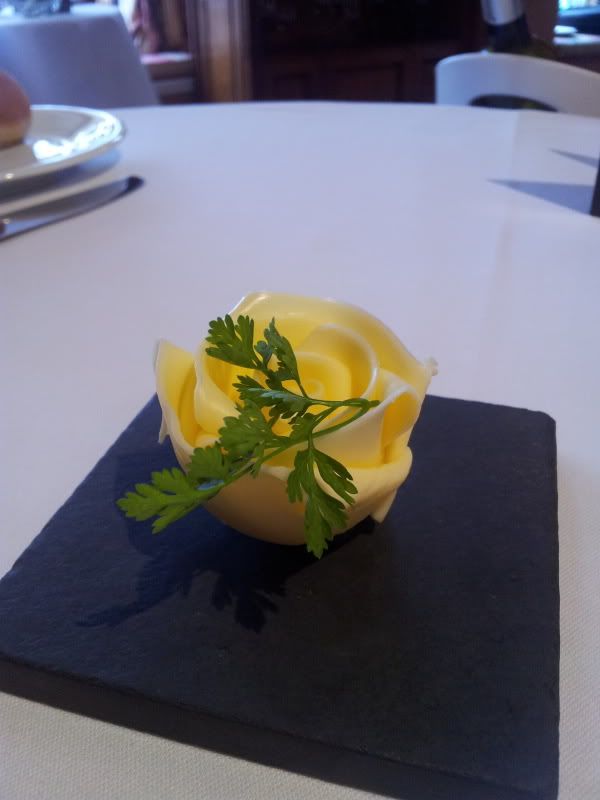
Butter rose
Presenting the butter as a rose doesn't improve its flavour of course, but it
shows an attention to detail, precision and a good degree of classical
skills.
The first dish to come out of the kitchen was an amuse bouche of homemade curd cheese with pickled vegetables.
Curd cheese and pickled vegetables
A nice start to a meal: light, fresh and extremely well balanced and certainly woke up the palate.
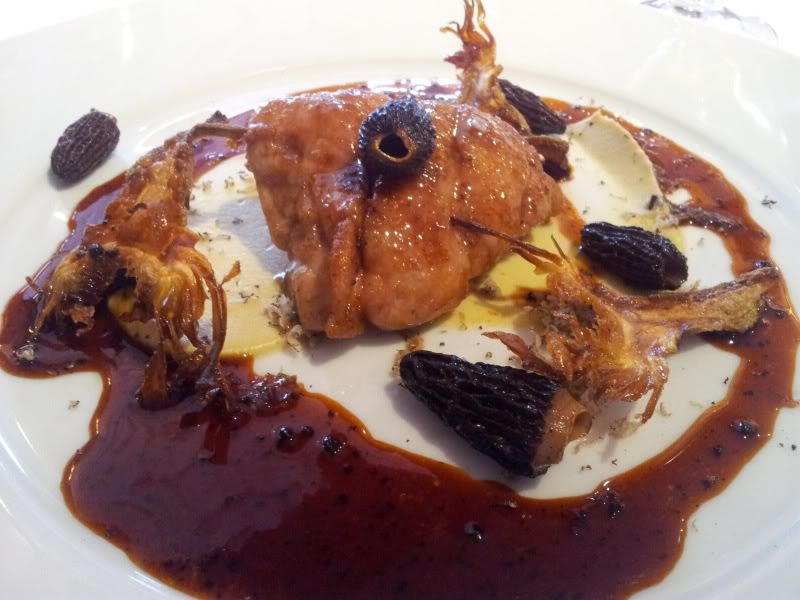
I started with a veal sweetbread, served with globe artichoke, morels and a truffled madeira sauce.
Glazed veal sweetbread with artichoke and madeira & truffle jus
A magnificent sweetbread, perfectly cooked, and undoubtedly one of the finest for some time. The madeira sauce was simply magnificent: good depth of flavour, yet still clean with all the truffle aromatics balanced perfectly and not dominating. The crisply fried artichoke slices were a method of preparation I don't recall coming across before, and together with the artichoke purée underneath the sweetbread, they worked brilliantly. You could have stopped there and had a great dish, but the addition of the morels lifted it into excellence.
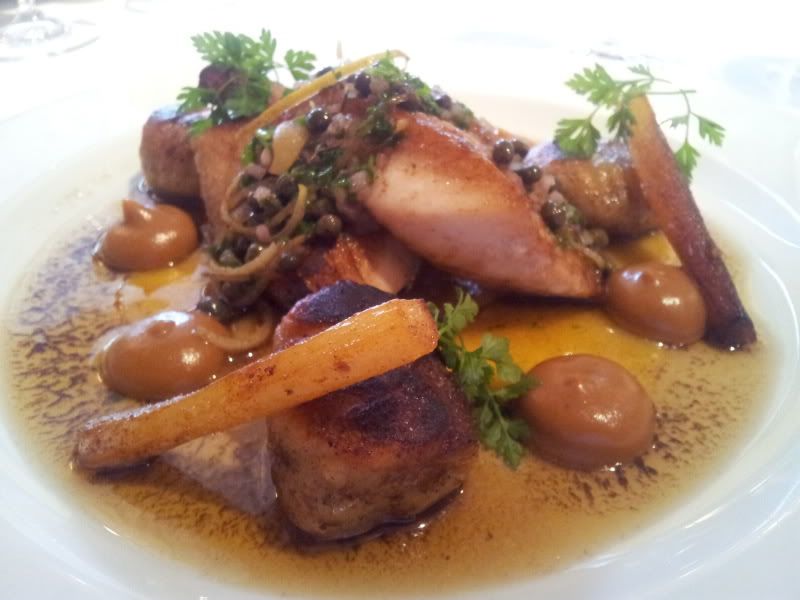
My main course was an equally magnificent pair of John Dory fillets, which came with truffled gnocchi, thin slices of turnip, caramelised shallots and a beurre noisette.
John Dory with truffled gnocchi, golden turnip, caramelised salsify purée
It goes without saying that the fish was excellent and perfectly cooked. The gnocchi were unusually large and looked like they should have been a bit leaden, but somehow they weren't. The salsify came both as a purée and as neatly turned pieces. This really was a good dish. If there were any criticism, it would be that it felt a little autumnal for a sunny, warm, early summer's day. (That couldn't be said of our other main course: some excellent turbot with orange, fennel and coriander.)
Cheeses from a well-stocked trolley were, naturally, all in prime condition, and included a Tunworth, which is without doubt currently my favourite cheese. Unlike some places, there was no supplement for cheese.
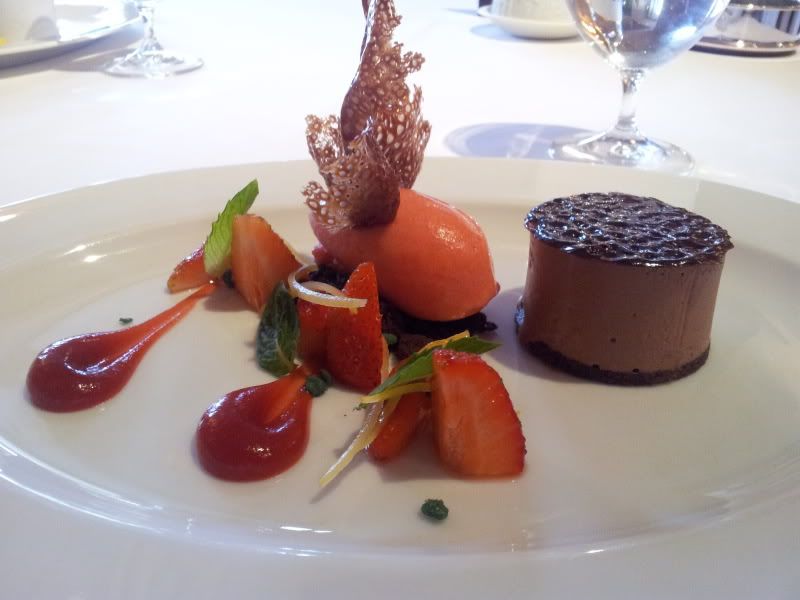
I don't normally have chocolate desserts, finding them often too rich and heavy. But the use of milk chocolate in a milk chocolate delice with strawberry, lemon and mint was a pleasant exception.
In terms of writing up a report, rather like this whole post, this dish was rather boringly perfect, with a well tried combination of flavours and textures.
Good coffee came with a large box of - presumably homemade - chocolates, which all tasted how they were supposed to. Though the ritual of the box, and dispensing your choices with tongs seemed a little strained compared to the rest of the both the food and the service. Anyway, what are you meant to have? One? Two? One of each? (I had three.)
Service throughout was just the right balance of formal and friendly. Before the meal, we had decided upon a shortlist of possible wines, but the maitre d' cum sommelier steered us away towards a white Bordeaux at half the price of our ideas, a 2007 Graves, Château Arzac Cuvée Lea, which was an excellent recommendation, working extremely well with all our dishes.
The Box Tree is not cheap, but then for a restaurant with this heritage, producing food of this quality, it should not be. But neither did we leave with any sense that this had not been a very good value meal.
As hard as we tried, it really was impossible to fault at this meal.
L'Enclume is famous for its multi-course tasting menus, drawing on very locally sourced and foraged ingredients. They're not cheap, but they are always good value; they're multi-course but are never over-facing.
But sometimes I'm a little short of cash and/or time, which is when one of the less well-known features of this excellent restaurant come in handy: the set table d'hôte lunch at £25 for 3+1 courses (3 advertised, plus an amuse). And you still get the brilliant bread that has had London foodies' tongues wagging at the new sister restaurant, Roganic.
On this occasion, my amuse was a porcelain sack filled with a layer of (cucumber?) jelly, then a very light beetroot mousse, all topped with a buffalo mozzarella snow and some pretty powerful dill flowers. Quite delicate, yet precise flavours, though I wasn't convinced by the texture of the mozzarella snow as it melted on the tongue to that not entirely pleasant mouthfeel that frozen cream has.
The starter proper was one of the best jerusalem artichoke dishes I've ever had. A cream of Ragstone cheese, topped with malt formed the base for cylinders of jerusalem artichoke and some crisps made from the artichoke skin. As ever, it looked beautiful. Though immediately, there's a surprise: it's cold. I can't remember the last time I had cold jerusalem artichoke, and when it was put down on the table, I don't know why, but it looked like the artichoke component was hot, or at least warm! It was a really lovely dish with a perfect balance of flavours. I can't help wondering what it would be like if, say, the skins had been hot. Would that add another dimension, or just spoil it?
Main course was a great piece of hogget (sheep over one year old), with various greenery stuff, including something called ground ivy. Cue slightly alarming moment: isnt' ivy poisonous? No, not this one. According to the usual internet sources of varying authority, it's a hedgerow plant, somehow related to mint that's been used in cheesemaking as an alternative to animal rennet and in brewing as an alternative to hops; though they say it's also poisonous to horses. I'm still alive. Another nice dish.
Dessert was one of those not overly sweet desserts that I particularly like and which L'Enclume does so well. Wild blackberries, gently poached, served with a beetroot sorbet, beetroot meringue and an utterly dreamy buttermilk set custard.