I probably go to the Parkers Arms in the tiny Ribble Valley village of Newton-in-Bowland more than I go to any other local pub or restaurant. The beer's good, the welcome and service are good (though occasionally struggle when under pressure on the busiest days). But above all, the food is genuinely and consistently interesting and excellent.
I could fill this blog with reports of meals at the Parkers Arms (follow me on Twitter for blow by blow details in the future), but I thought for once, I'd just present a photograph gallery of images from recent meals in 2013. Everything at the Parkers Arms is homemade (the only exception I can think of is the bacon and gammon which come from the excellent Roaming Roosters near Burnley), so rather than me repeating that in the caption to each photograph, please assume it.
I hope you enjoy looking at them as much as I enjoyed eating the dishes!
Starters
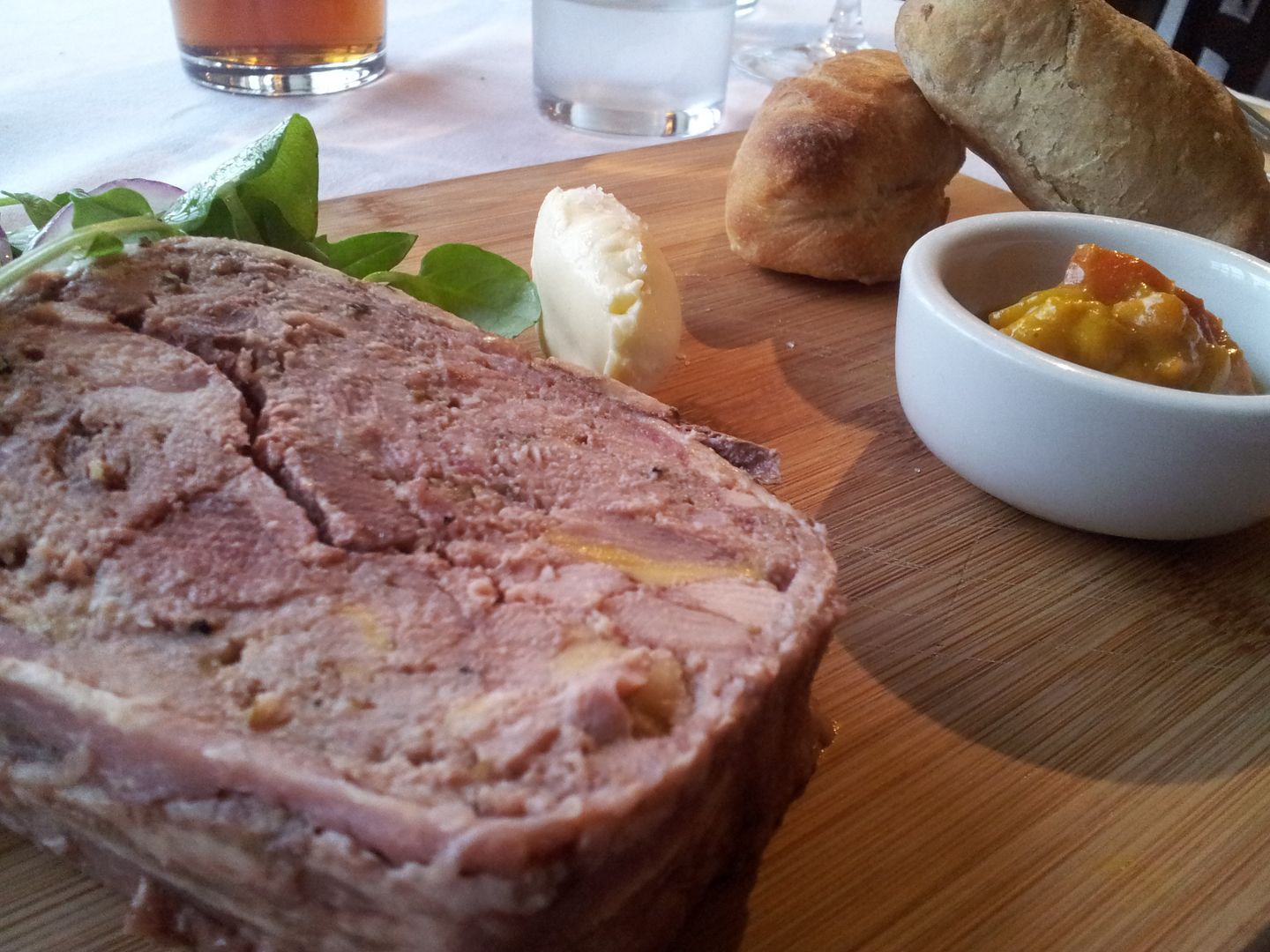
Game terrine with piccallili
Pastrami with treacle bread
Stosie has now got her pastrami spot on, and as for that bread ... well that's almost worth the trip on its own.
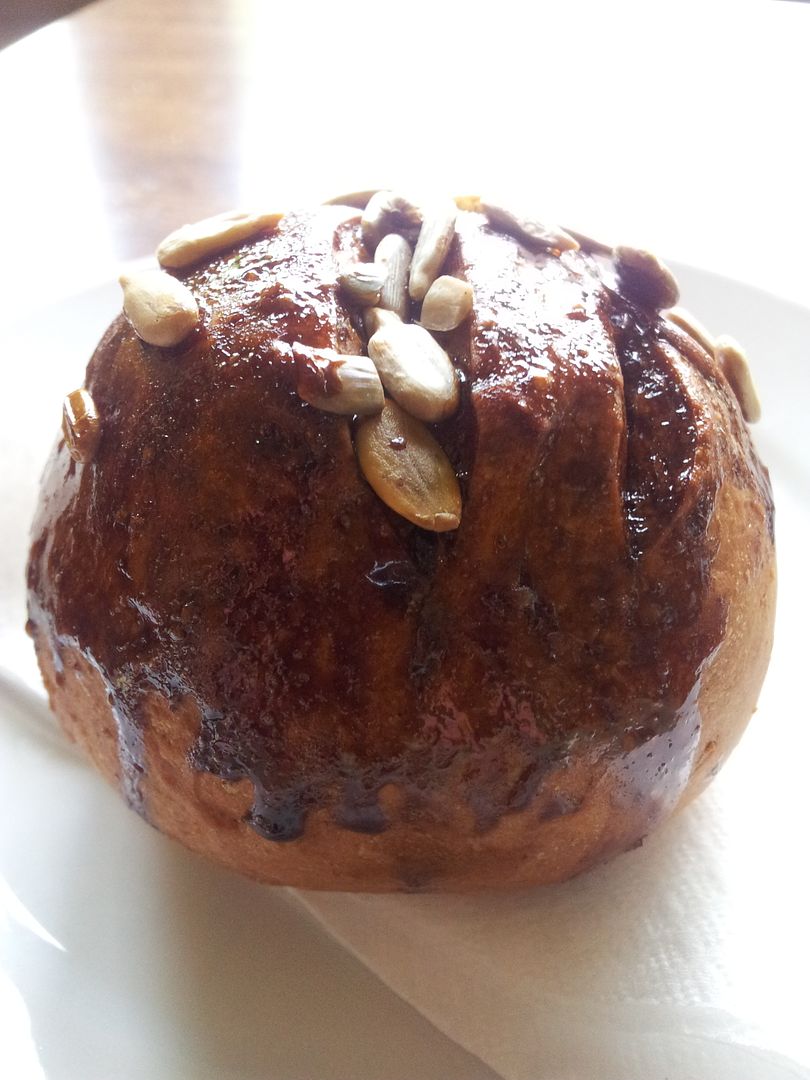
The treacle bread
Cheese scone with tomatoes
On this occasion, I'd asked for a small tasting menu, and this cheese scone was the first course out: not something I'd have ordered, but it was jolly good - a very light scone with a nice cheesy flavour
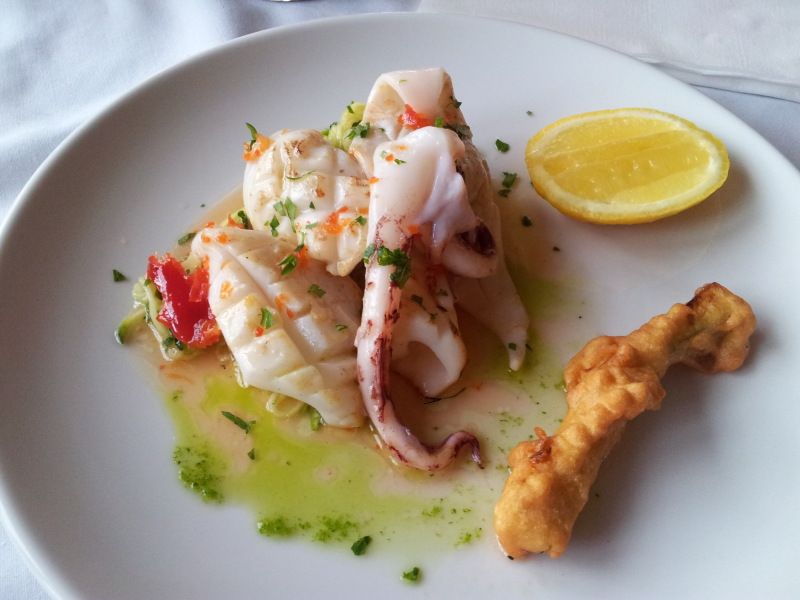
Beautiful buttery squid
Mushroom parfait
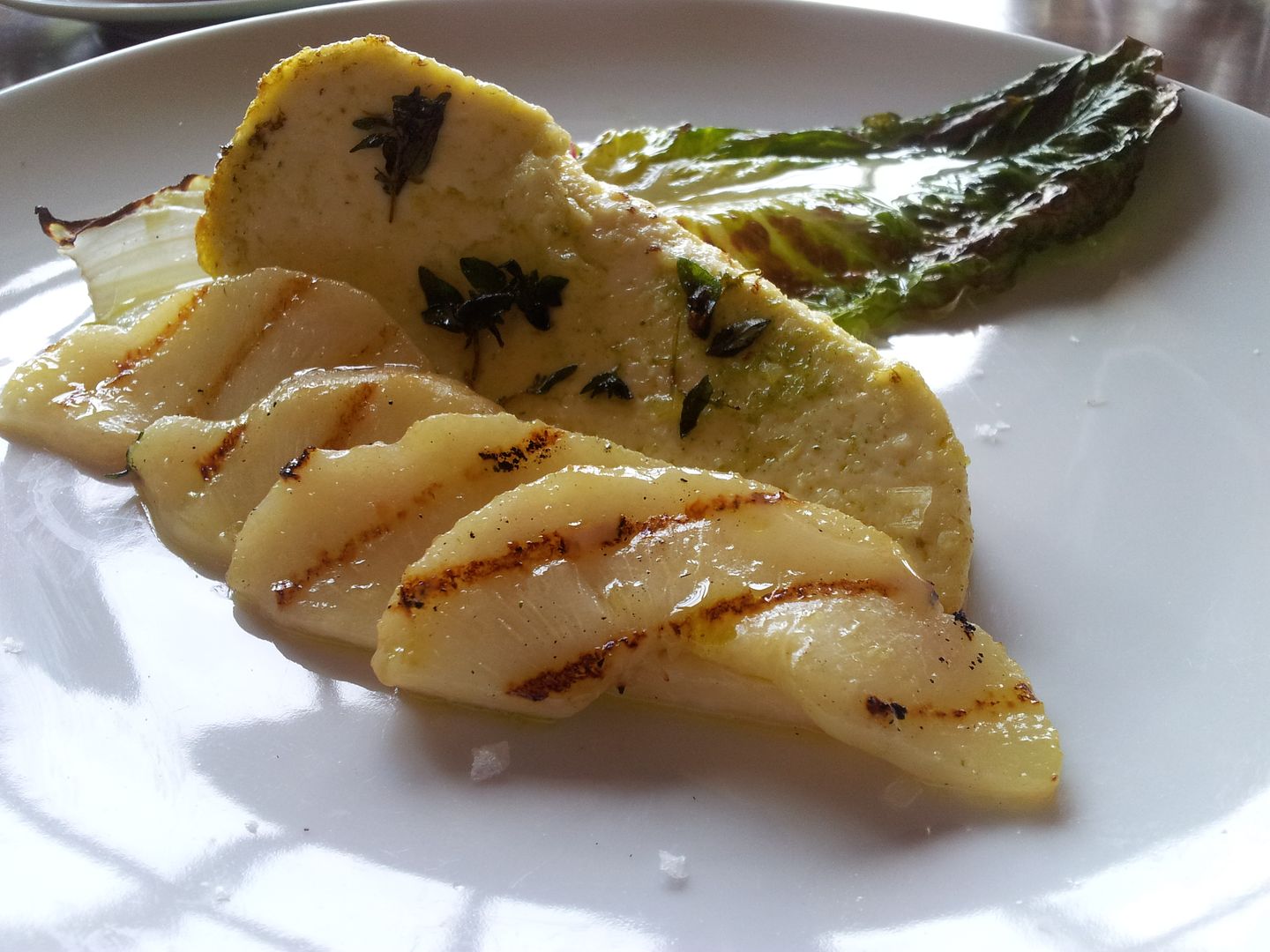
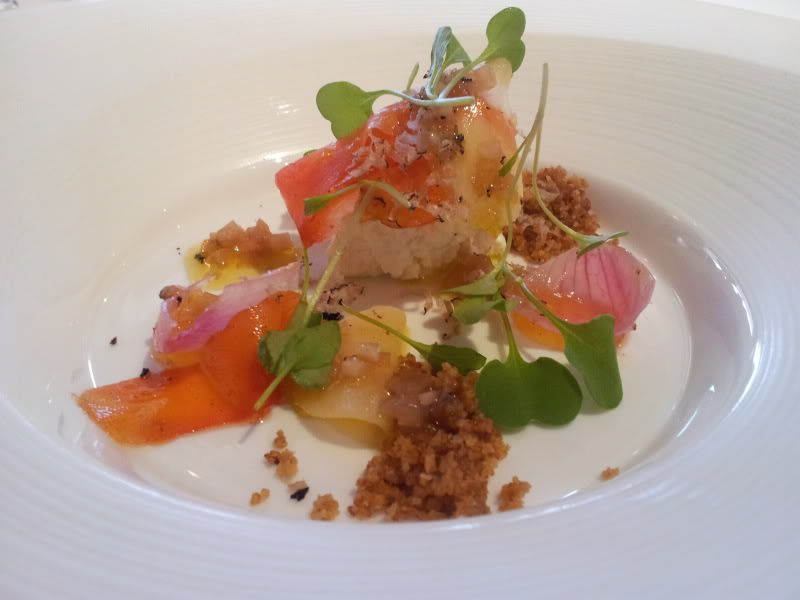
Curd cheese with grilled white peaches
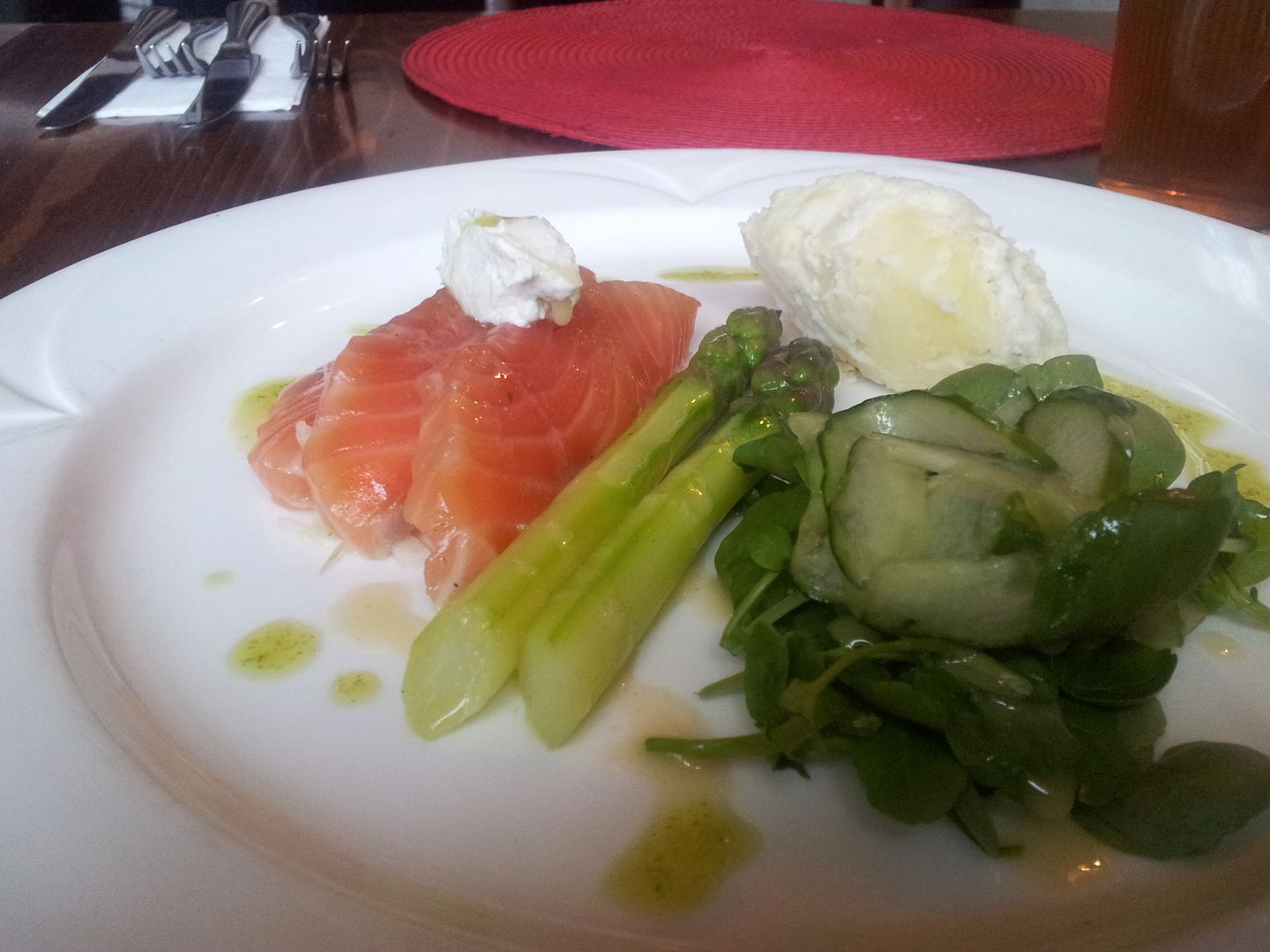
Cured salmon with horseradish cream
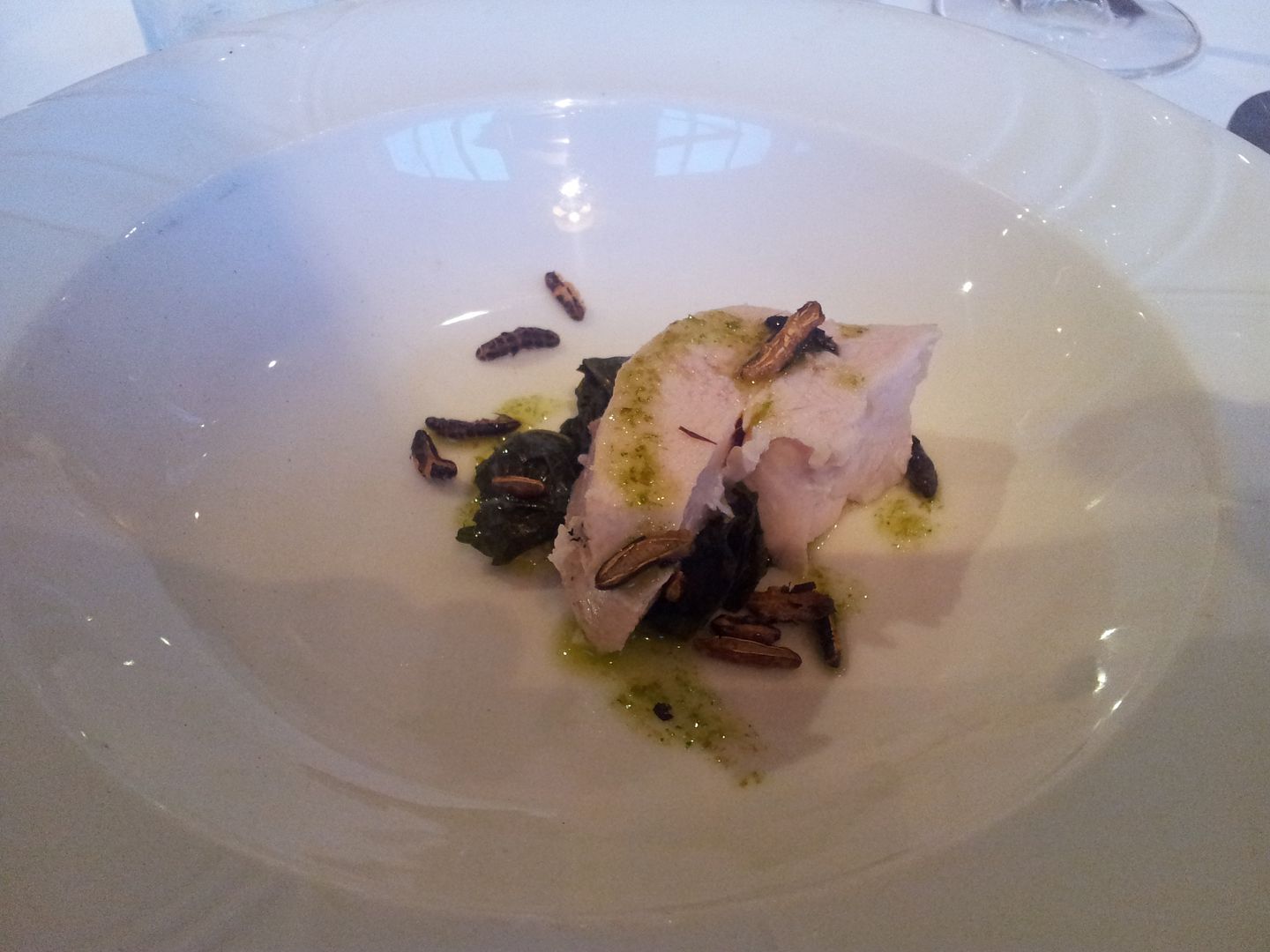
Wild garlic custard with chicken scratchings
Main courses
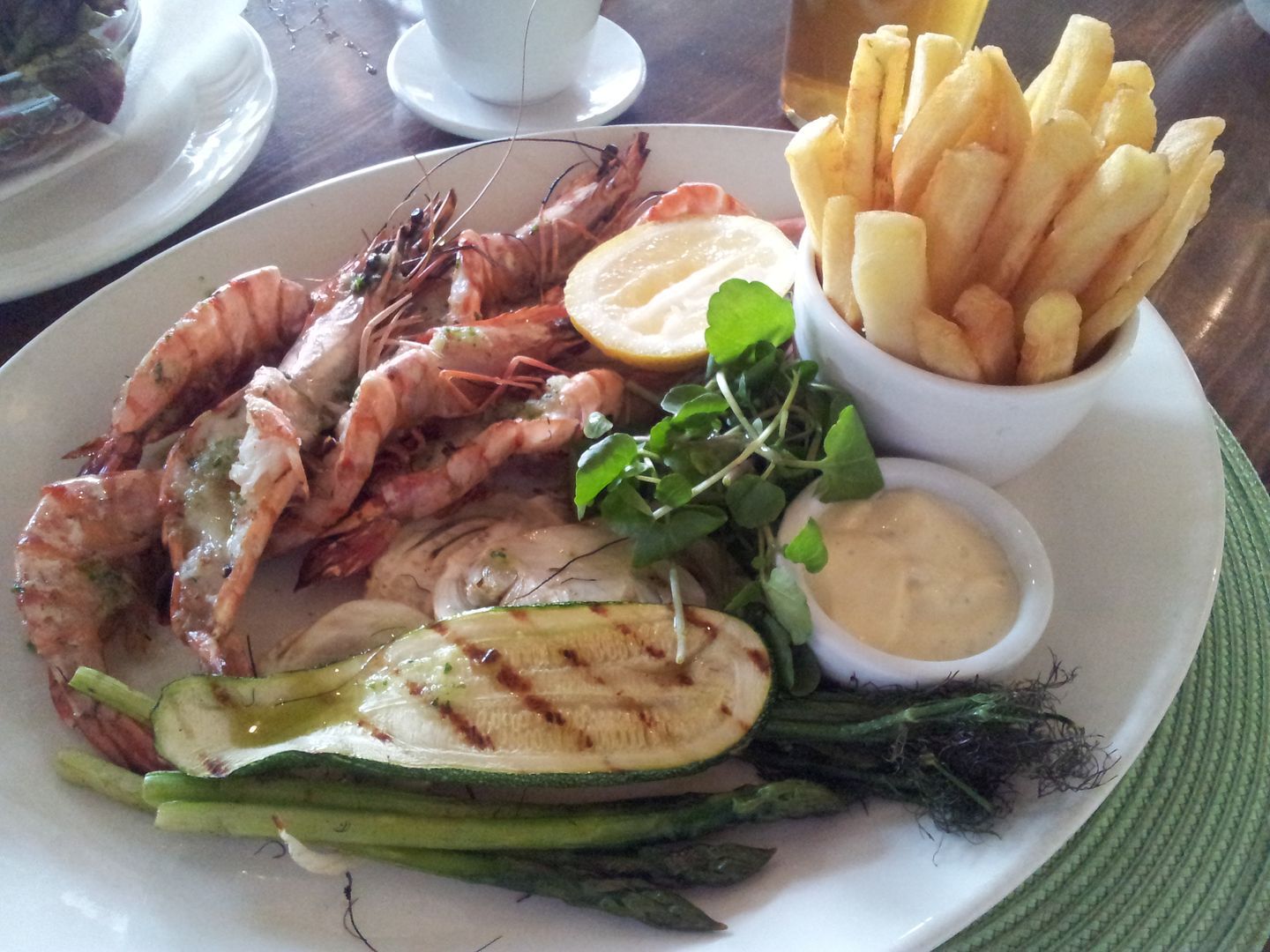
Prawns and vegetables grilled on Stosie's new toy, a Primo BBQ.
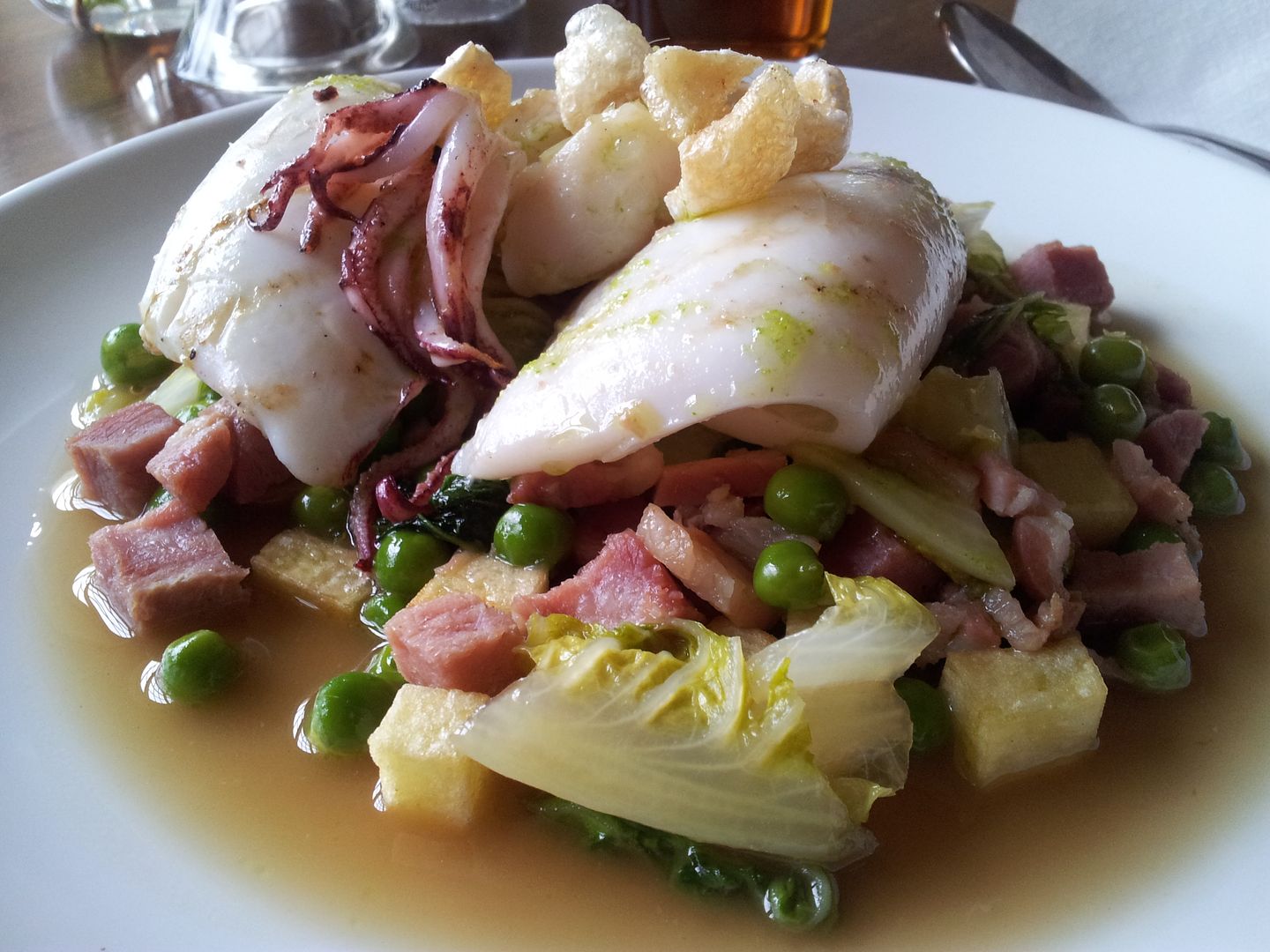
Squid with extra hammy petits pois à la française
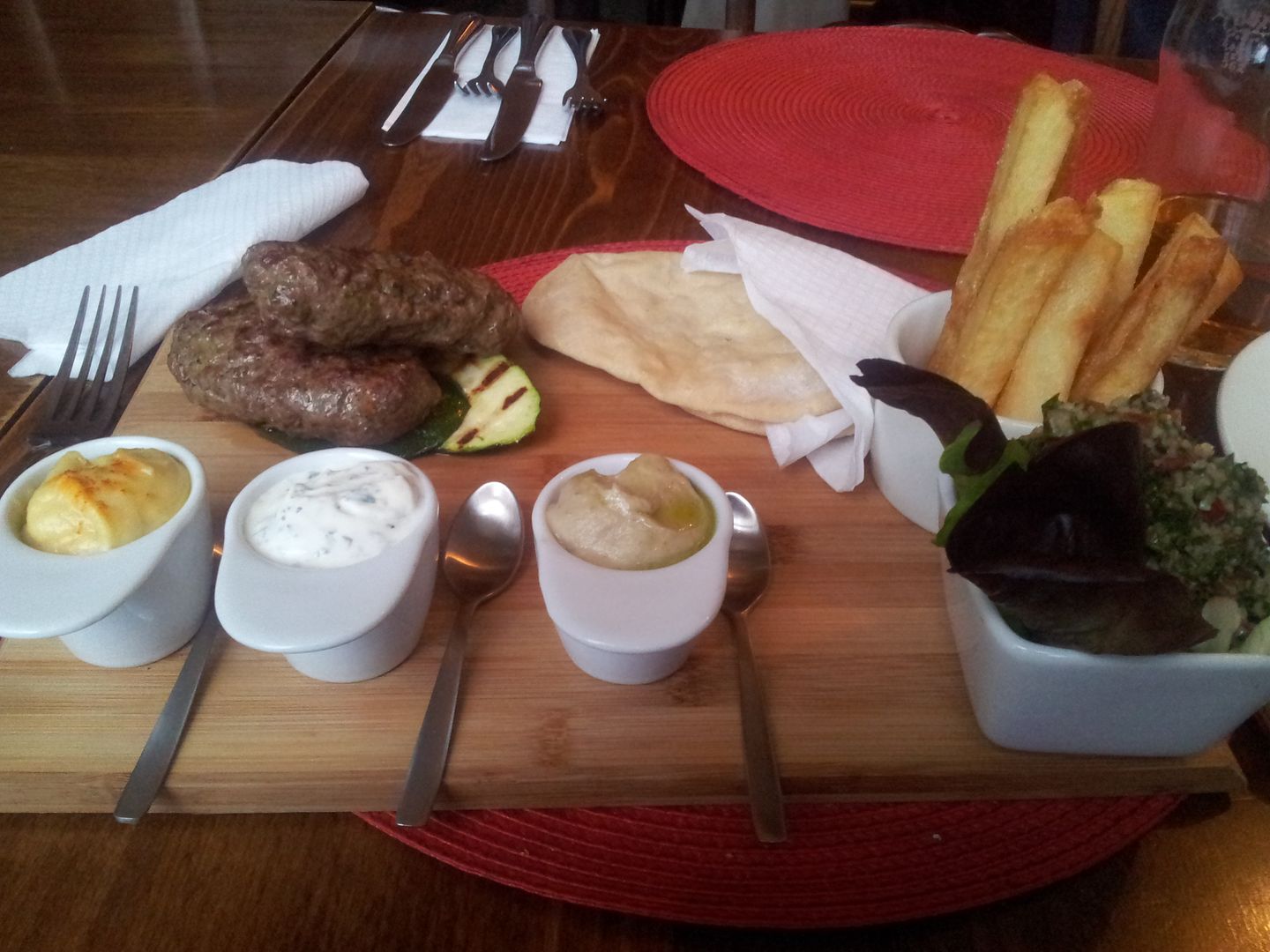
Lamb kofte - beautifully and delicately spiced, excellent hummus, tzatziki and baba ghanoush in the little pots
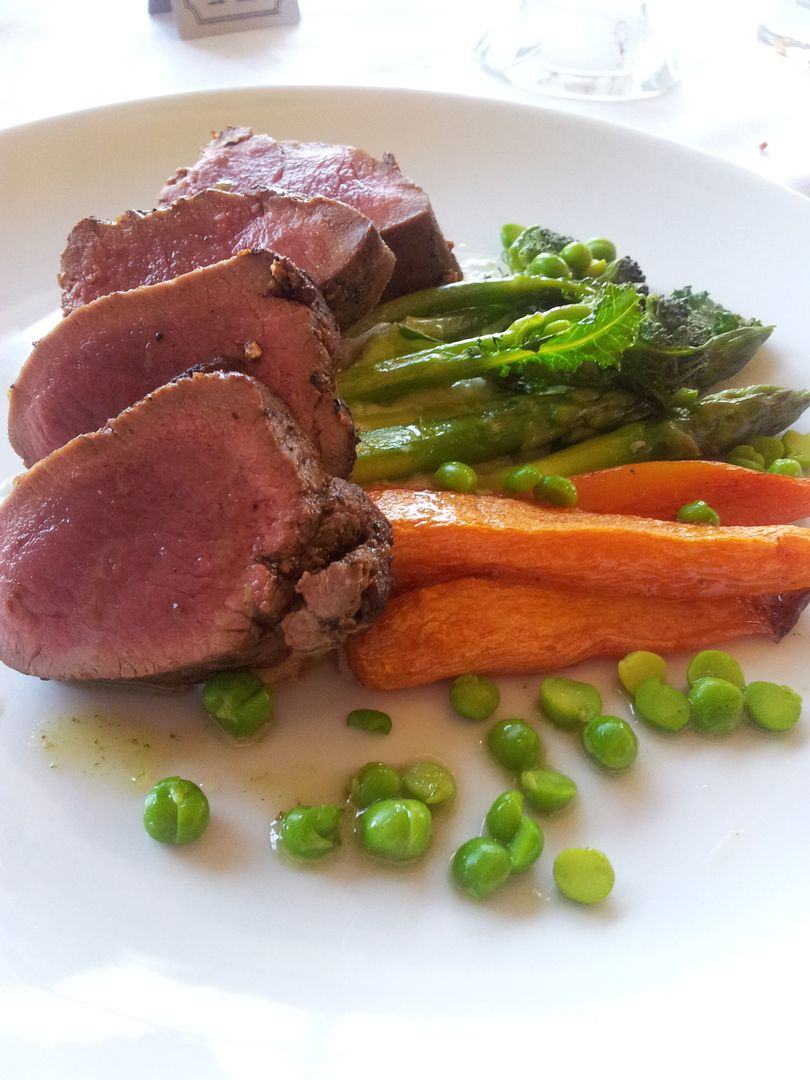
Beautiful, simple spring lamb
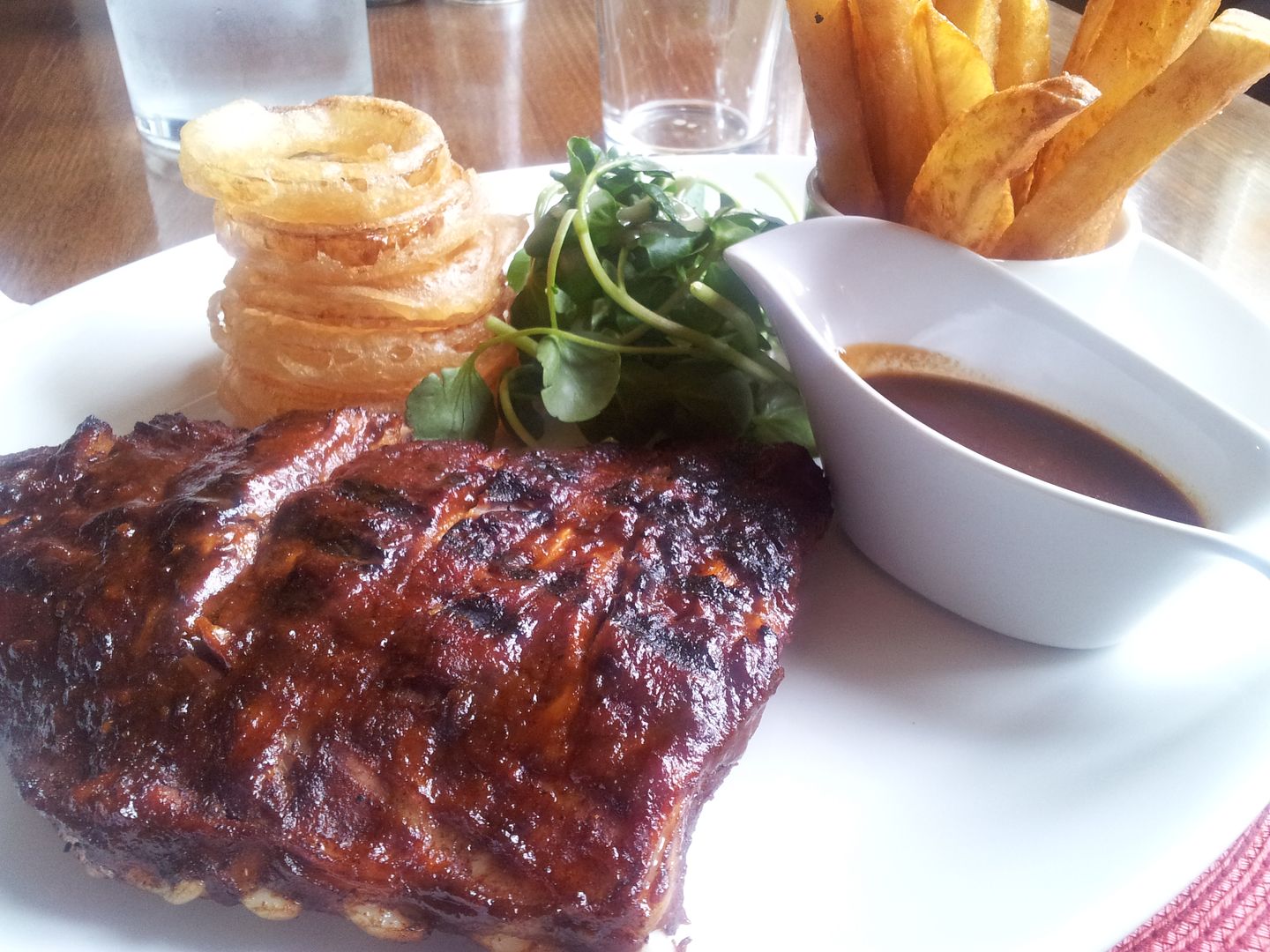
Spicy BBQ baby back ribs. Fab French fried onions too.
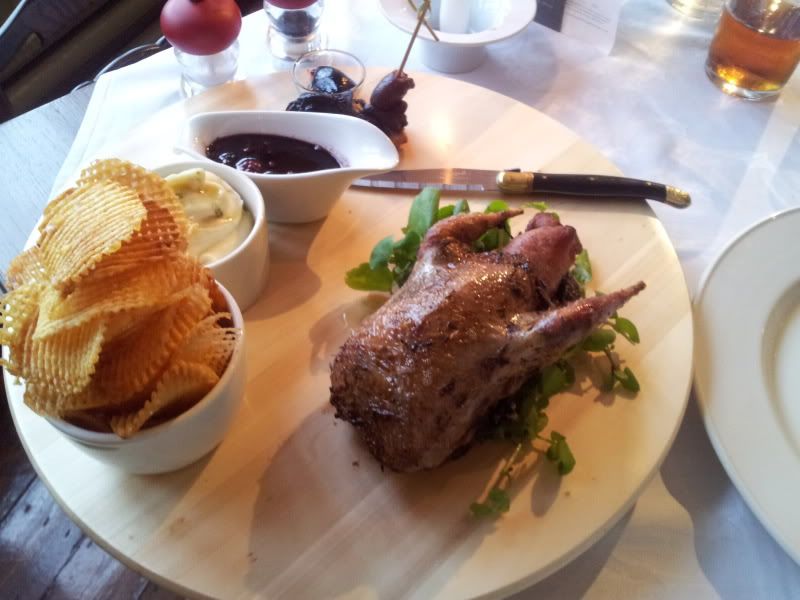
Grouse done properly
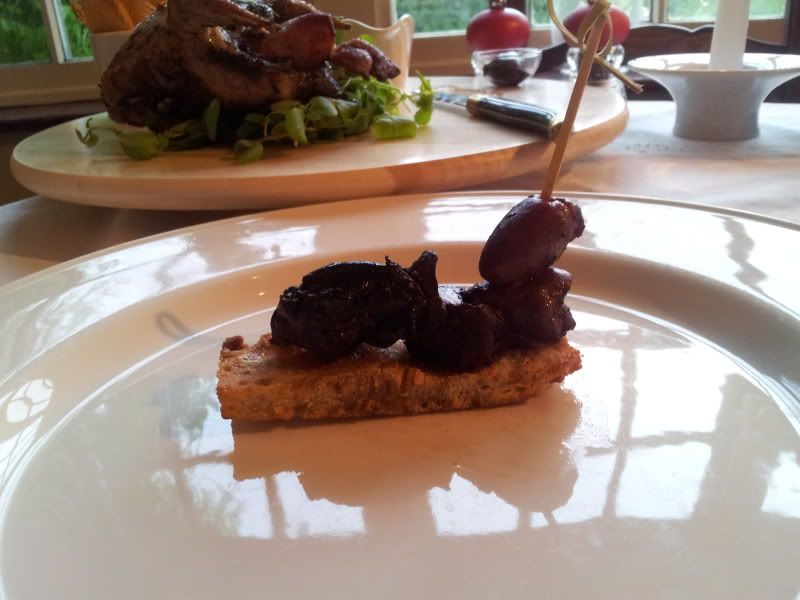
The grouse liver, kidney and heart
Desserts
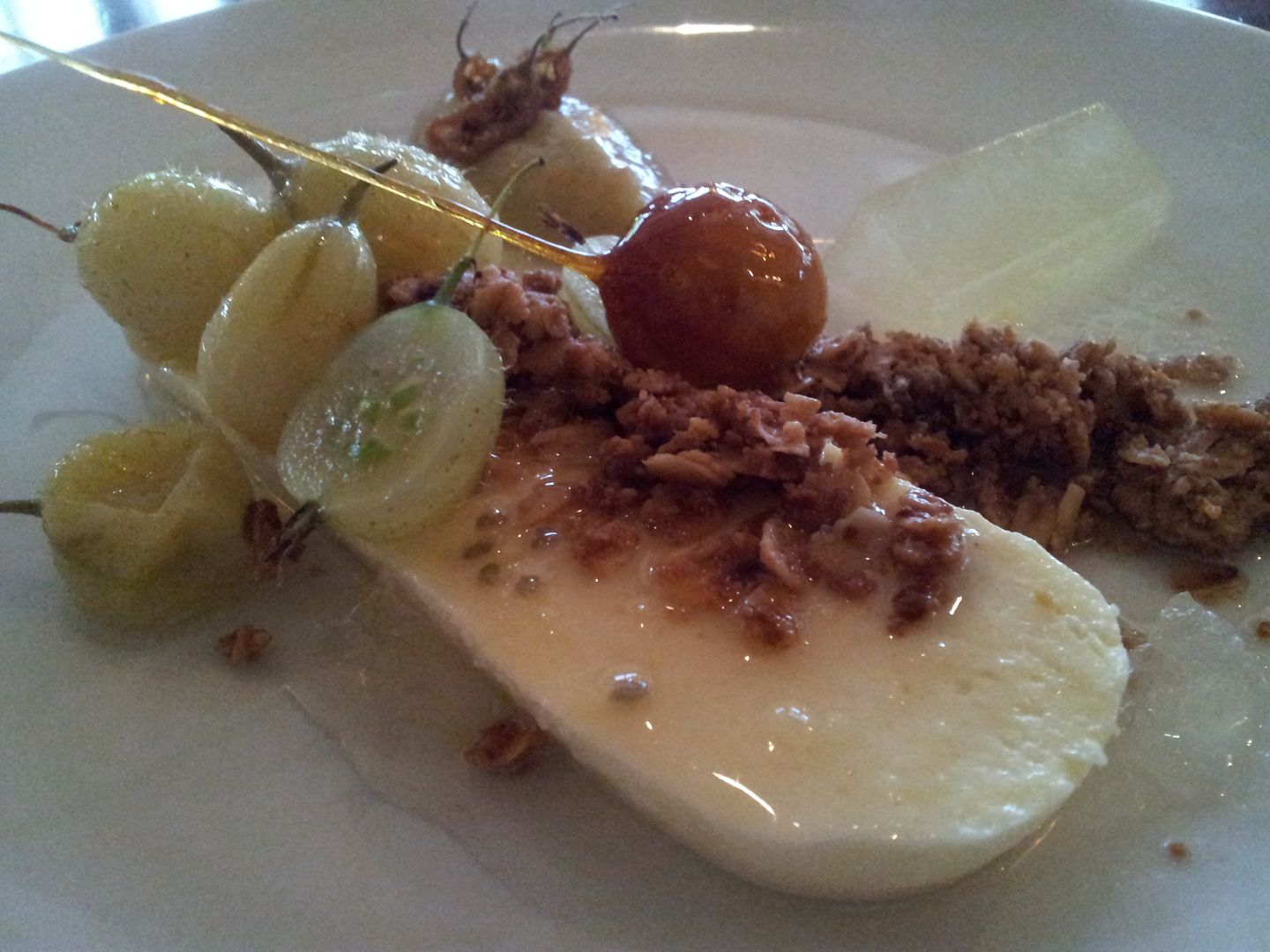
Stosie's curd cheese with a variety of gooseberry preparations
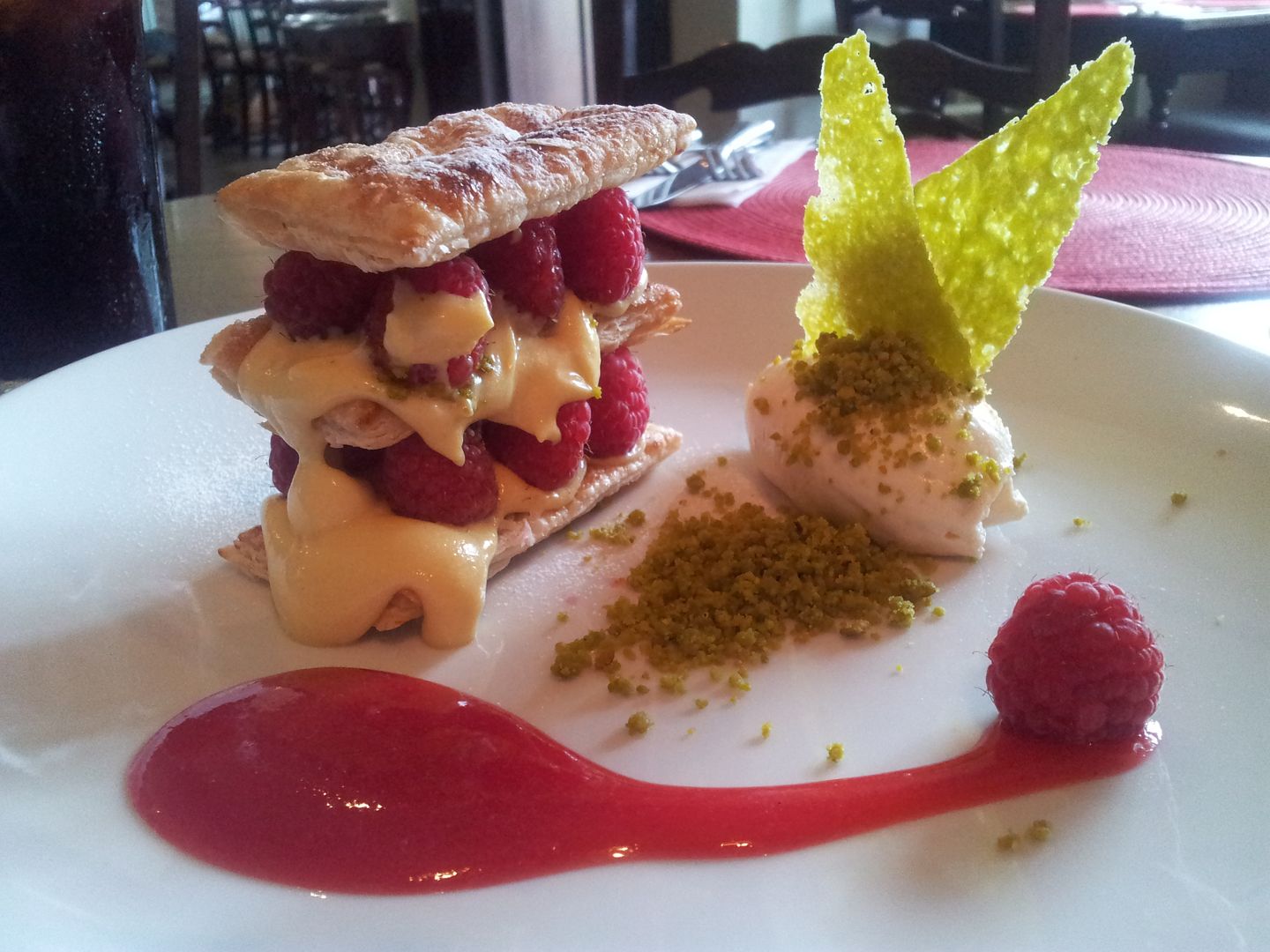
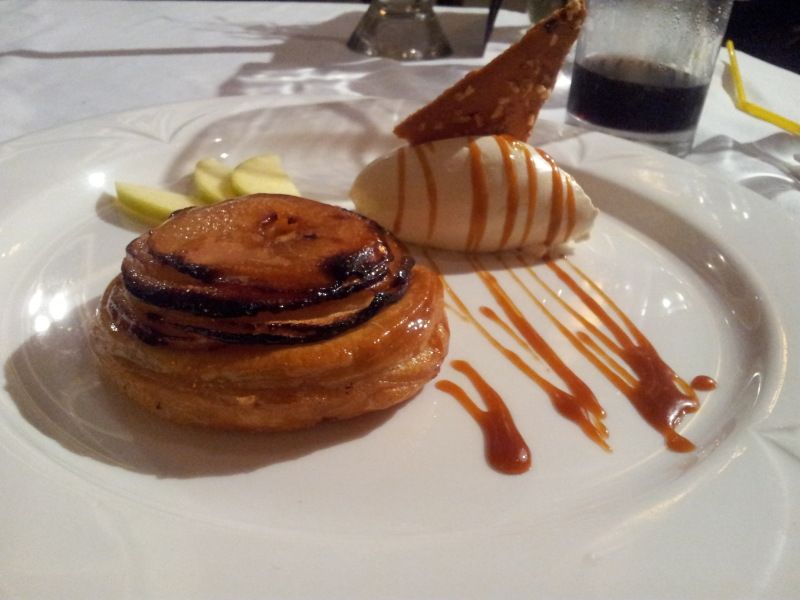
Raspberry-vanilla slice
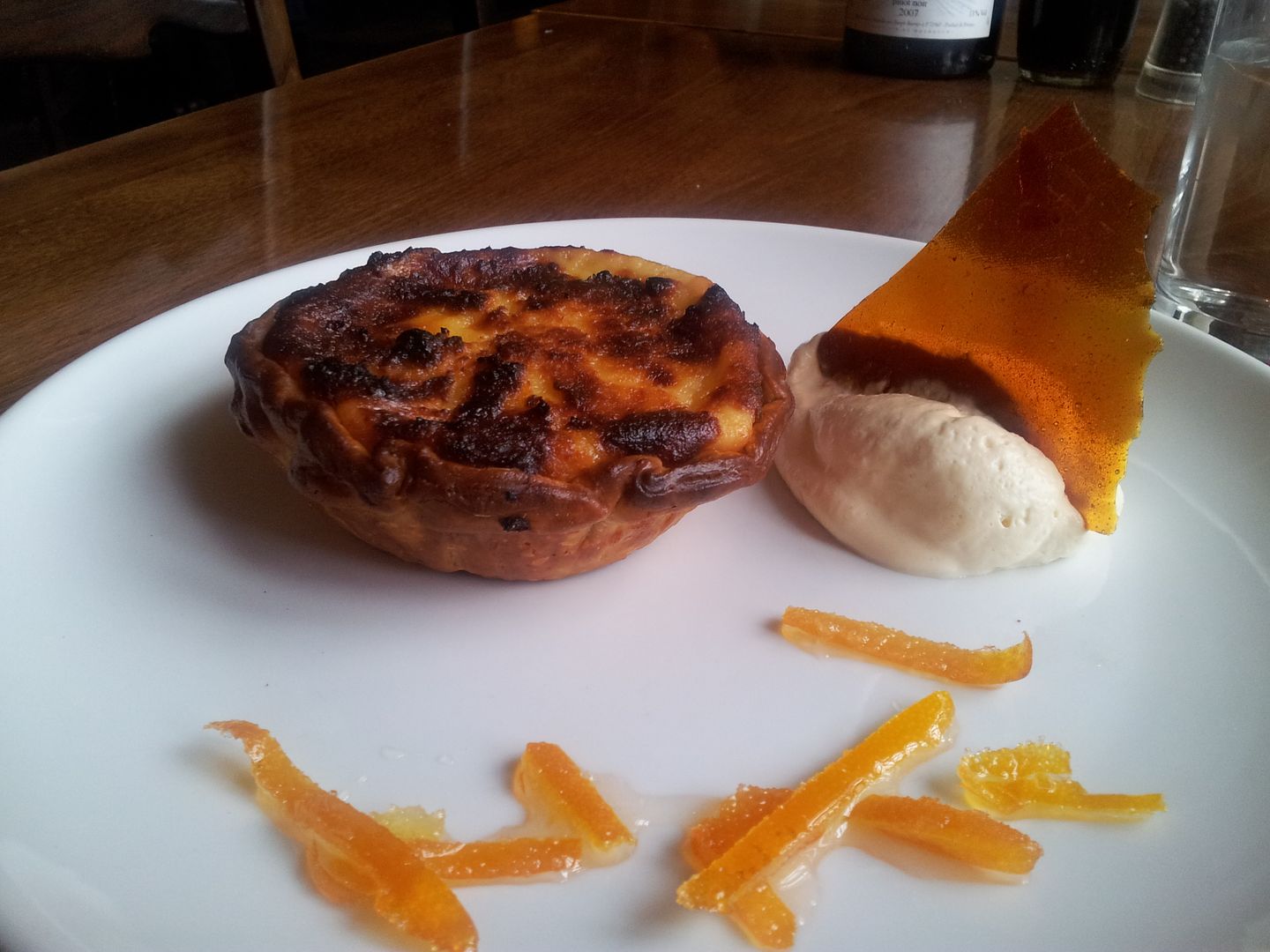
The pasteis de nata (Portuguese custard tarts) are a must if they're on the menu
This 18th century farmhouse on the main road into Ilkley has been The Box Tree since 1962 when Malcolm Reid and Colin Long (often known simply as "the boys") opened what came to be one of the most important restaurants in the north of England, earning one Michelin star when Michelin re-started publication of its UK guide in 1974, and holding two stars from 1977 to 1986.
It went into a bit of a decline after Messrs Reid and Long moved on in 1986, though it kept one Michelin star until 1991. It was then bought and pretty much resurrected by the formidable Madame Avis in 1992. The Box Tree regained its Michelin star under Madame Avis' ownership in 1996, and held on to it until 2002, when she lost interest largely as a result of her husband being diagnosed with a terminal illness. She leased (and subsequently sold) the Box Tree to the current owners, Simon and Rena Gueller in 2004, who regained the Michelin star in 2005, which it has held ever since.
I vaguely remember the Box Tree when the boys had it, and it's still very much recognisable as their restaurant, though fortunately the uncomfortable chairs seem to have gone: whenever we came across uncomfortable chairs, they were always said in our family to be "in the running for the Box Tree prize." Little changed under Madame Avis, though it did start to feel increasingly dowdy and in parts in need of a deep clean.
We recently returned to the Box Tree after a couple of years absence, and were completely baffled as to why we don't go more often. The food was, throughout, completely faultless and simply a joy. Fairly classical, but light dishes, well-conceived and perfectly executed.
We started in the dark bar-lounge area with some canapés which, on the face of it, didn't look terribly inspiring: some thin crisp flatbreads and two bowls, one of a salmon mousse and the other of, I think, a red pepper mousse. We were immediately struck by how well seasoned the mousses, particularly the salmon one were. A very minor criticism might be that the flatbreads were a bit too thin and crisp for dipping into the mousses, as, without care, they tended to break under the weight.
The lounge/bar area
In contrast to the bar area, the two dining rooms are fresh, bright, smart rooms, with good art and quality knick knacks such as large Herend animals. The butterflies painting, much coveted by Marco Pierre White, is however gone. Despite the closeness to the busy road, the dining rooms are well insulated from traffic noise. Tables are classically set with pressed white cloths and good cutlery and glassware.
Immediately bread and butter show respectively the emphasis on flavour backed up by technique, and an attention to detail.
Excellent bread.
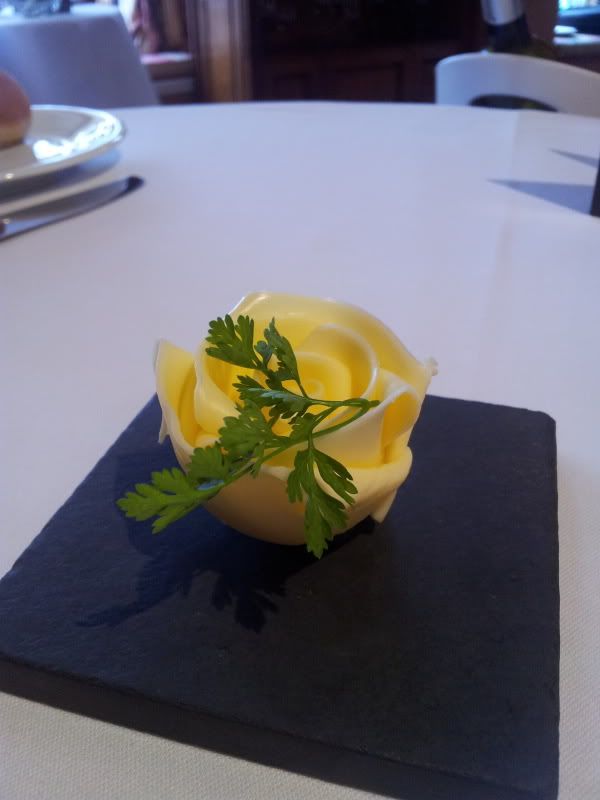
Butter rose
Presenting the butter as a rose doesn't improve its flavour of course, but it
shows an attention to detail, precision and a good degree of classical
skills.
The first dish to come out of the kitchen was an amuse bouche of homemade curd cheese with pickled vegetables.
Curd cheese and pickled vegetables
A nice start to a meal: light, fresh and extremely well balanced and certainly woke up the palate.
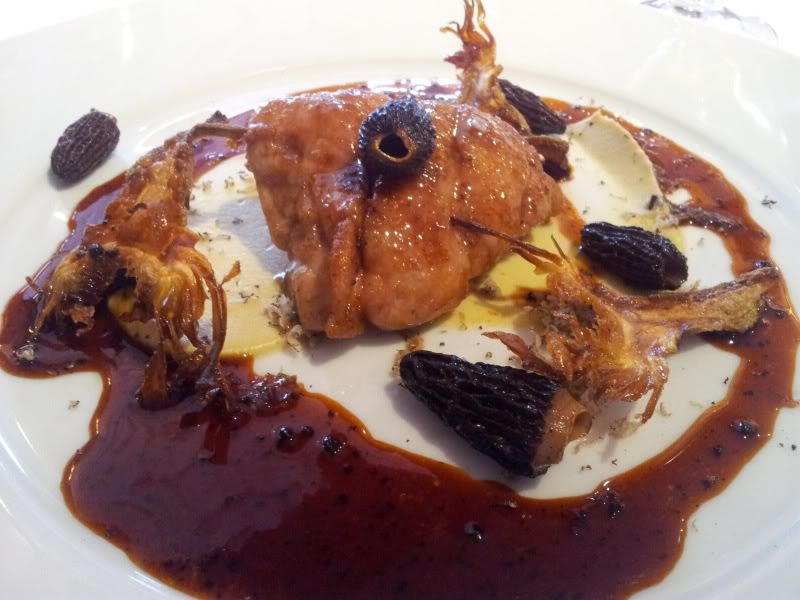
I started with a veal sweetbread, served with globe artichoke, morels and a truffled madeira sauce.
Glazed veal sweetbread with artichoke and madeira & truffle jus
A magnificent sweetbread, perfectly cooked, and undoubtedly one of the finest for some time. The madeira sauce was simply magnificent: good depth of flavour, yet still clean with all the truffle aromatics balanced perfectly and not dominating. The crisply fried artichoke slices were a method of preparation I don't recall coming across before, and together with the artichoke purée underneath the sweetbread, they worked brilliantly. You could have stopped there and had a great dish, but the addition of the morels lifted it into excellence.
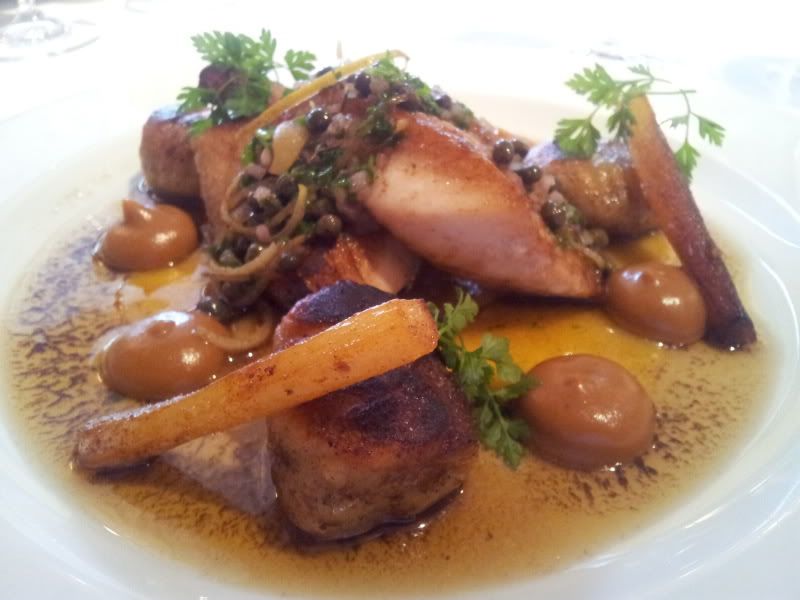
My main course was an equally magnificent pair of John Dory fillets, which came with truffled gnocchi, thin slices of turnip, caramelised shallots and a beurre noisette.
John Dory with truffled gnocchi, golden turnip, caramelised salsify purée
It goes without saying that the fish was excellent and perfectly cooked. The gnocchi were unusually large and looked like they should have been a bit leaden, but somehow they weren't. The salsify came both as a purée and as neatly turned pieces. This really was a good dish. If there were any criticism, it would be that it felt a little autumnal for a sunny, warm, early summer's day. (That couldn't be said of our other main course: some excellent turbot with orange, fennel and coriander.)
Cheeses from a well-stocked trolley were, naturally, all in prime condition, and included a Tunworth, which is without doubt currently my favourite cheese. Unlike some places, there was no supplement for cheese.
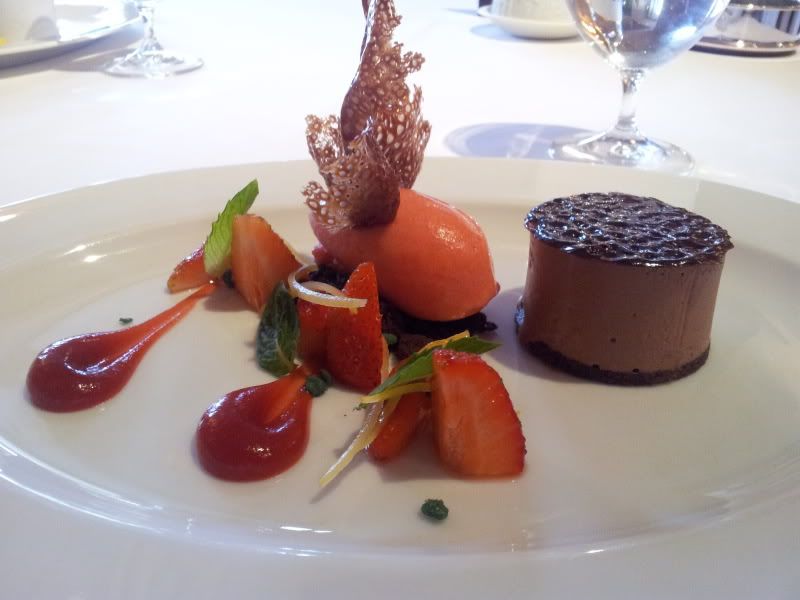
I don't normally have chocolate desserts, finding them often too rich and heavy. But the use of milk chocolate in a milk chocolate delice with strawberry, lemon and mint was a pleasant exception.
In terms of writing up a report, rather like this whole post, this dish was rather boringly perfect, with a well tried combination of flavours and textures.
Good coffee came with a large box of - presumably homemade - chocolates, which all tasted how they were supposed to. Though the ritual of the box, and dispensing your choices with tongs seemed a little strained compared to the rest of the both the food and the service. Anyway, what are you meant to have? One? Two? One of each? (I had three.)
Service throughout was just the right balance of formal and friendly. Before the meal, we had decided upon a shortlist of possible wines, but the maitre d' cum sommelier steered us away towards a white Bordeaux at half the price of our ideas, a 2007 Graves, Château Arzac Cuvée Lea, which was an excellent recommendation, working extremely well with all our dishes.
The Box Tree is not cheap, but then for a restaurant with this heritage, producing food of this quality, it should not be. But neither did we leave with any sense that this had not been a very good value meal.
As hard as we tried, it really was impossible to fault at this meal.
Chateau Musar wine tasting night 11th May 2013 Parkers Arms Newton-in-Bowland
I've been a fan of Chateau Musar, the best known of the several wine producers in Lebanon, for many years now, and I've been a fan of the Parkers Arms almost since the current team headed by Stosie Madi in the kitchen took over a few years ago. Stosie has some Lebanese ancestry, and I've always kept an eye out for anything middle-eastern on the menu (the lamb kofte with home-made pitta breads, for example, are always a joy).
So it was a privilege, through the medium of Twitter, to introduce Stosie and Ralph Hochar of Chateau Musar UK, and let them get on with coming up with a plan.
This evening was the result of that planning. Stosie created what read like a traditional Lebanese menu, but was strongly influenced by the wonderful ingredients that Lancashire can offer, her own style of cooking and a pinch of understanding of what her customers would eat. The wines were chosen by Ralph Hochar and sourced through D Byrne & Co of Clitheroe.
For more background on Chateau Musar and some tasting notes on some remarkable old vintages, see my post here.
(I should add the disclaimer that as a result of the introduction of Stosie Madi and Ralph Hochar, and
the encouragement I gave to the development of this evening, I was given a discount for the evening. My comments are, however, not influenced by the not-at-all-a-freebie, and my attempts to find different superlatives all reflect the quality of the cooking.)
We started in the bar with copious quantities of Musar Jeune Rosé 2011 and platters of mezze circulating.
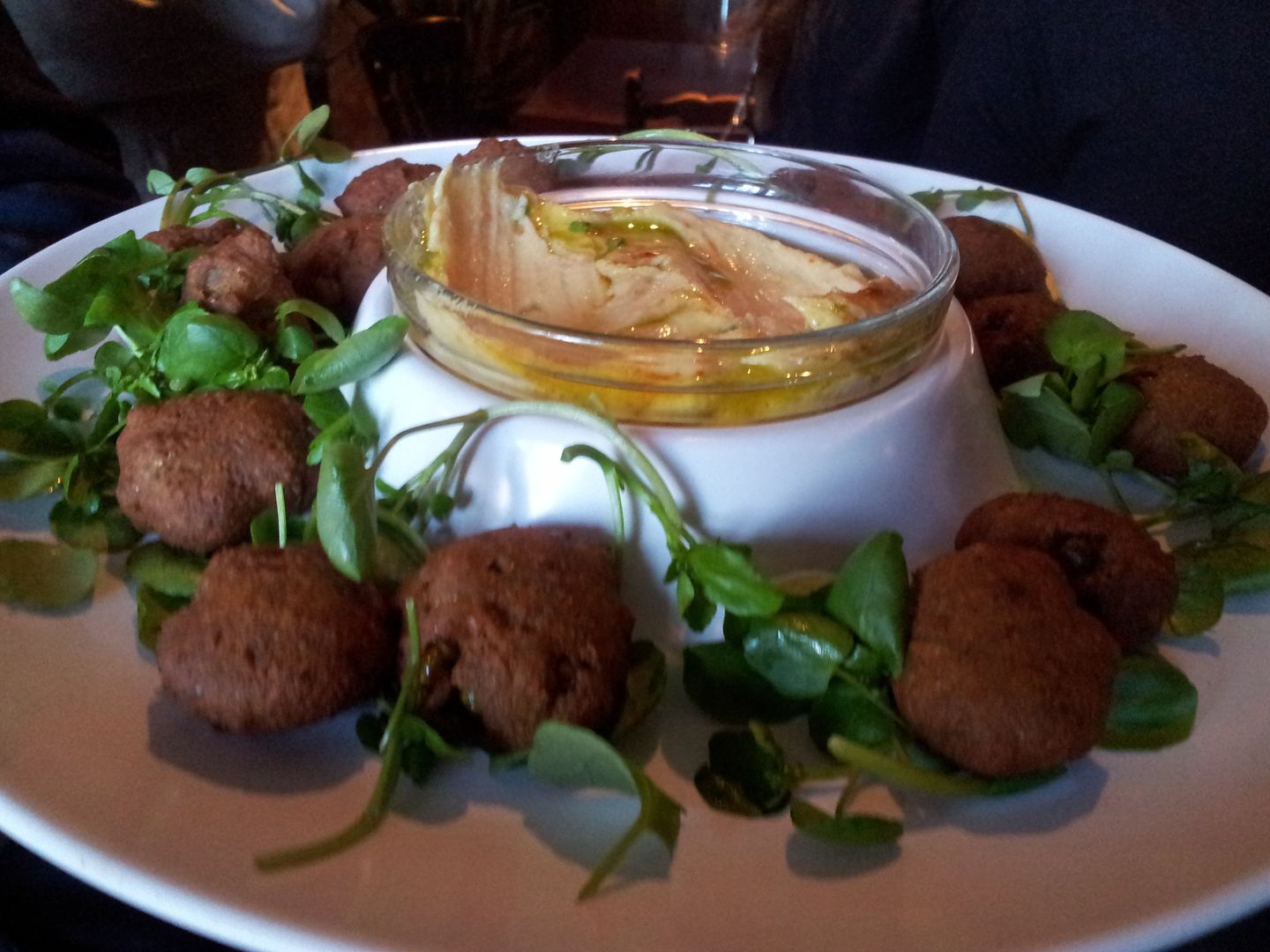
Unfortunately balancing glass and camera, together with half-eaten platters doesn't make for particularly appealing photographs. Falafels, made with garden peas as well as chickpeas, were light and tasty, and came with a lovely smooth hummus.
Falafels
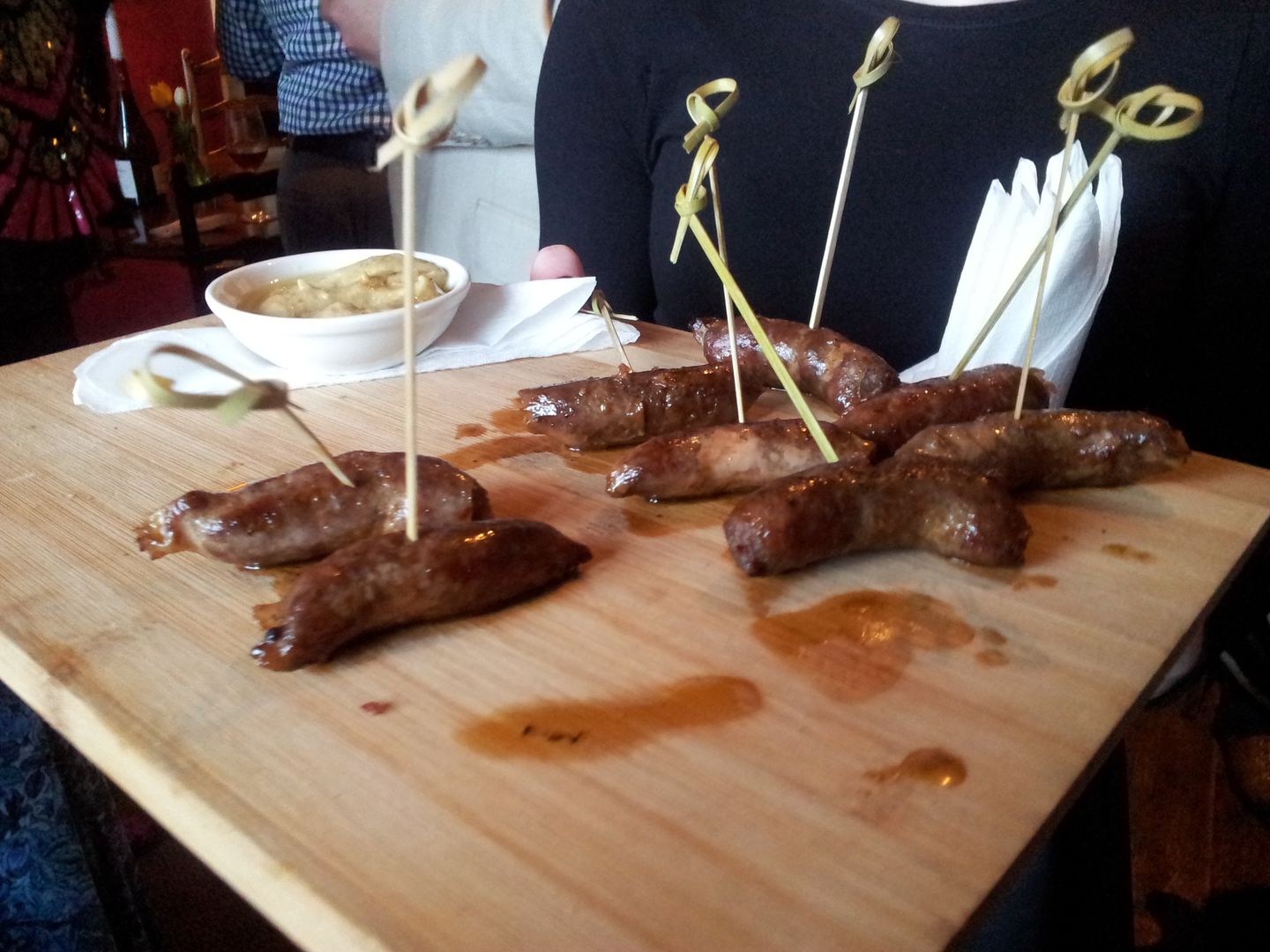
The Makanek sausages, made and smoked in-house from local lamb and beef, were particularly good, having been given a pomegranate molasses crust before being grilled over charcoal. These came with another dip: an excellent smoky baba ghanoush. I'd be delighted if these made a reappearance on the Parkers Arms menus.
Makanek sausages
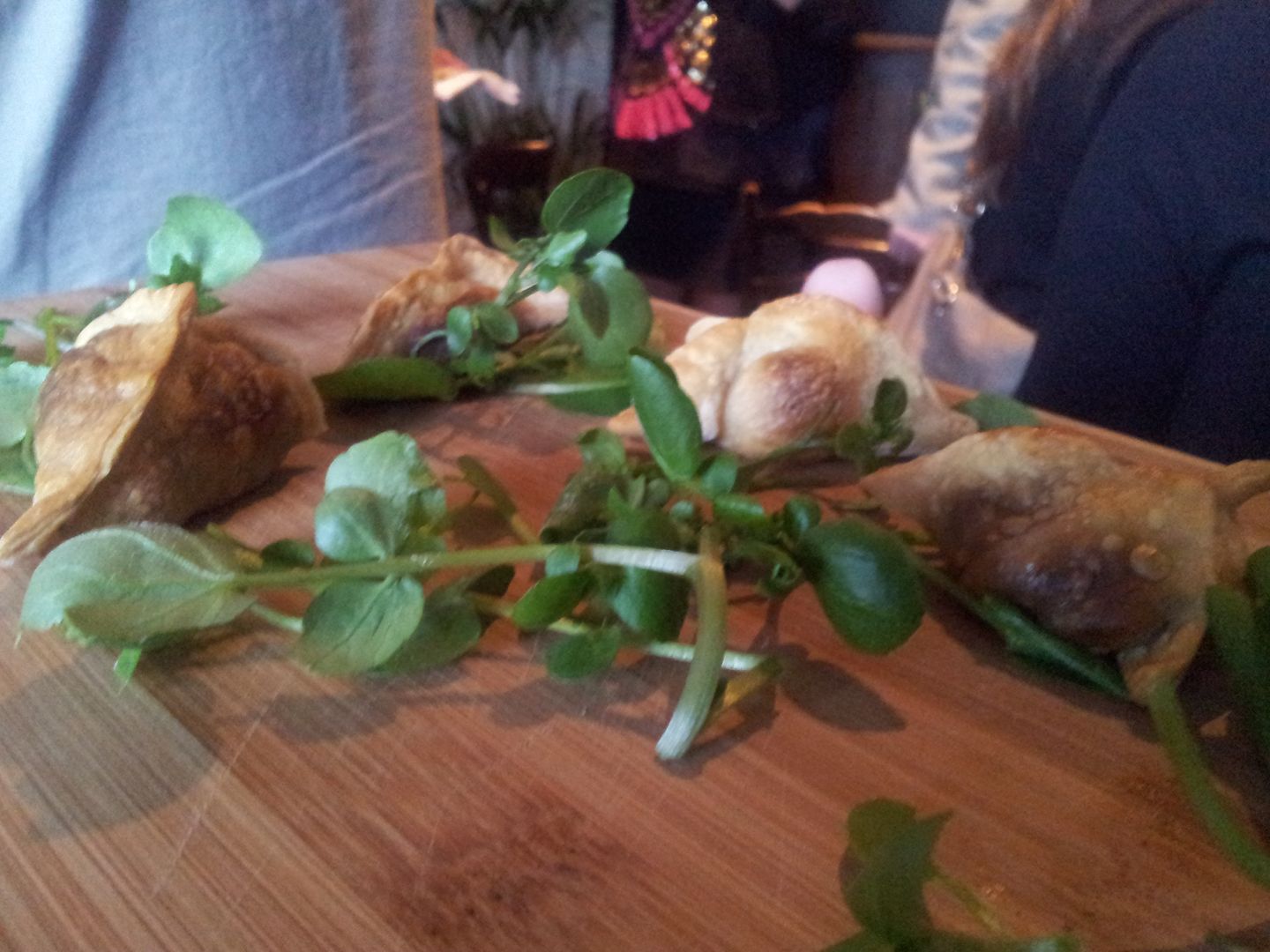
Fatayer were great little pasties with a sweetish and very moreish filling of wild garlic and caramelised onion.
Fatayer
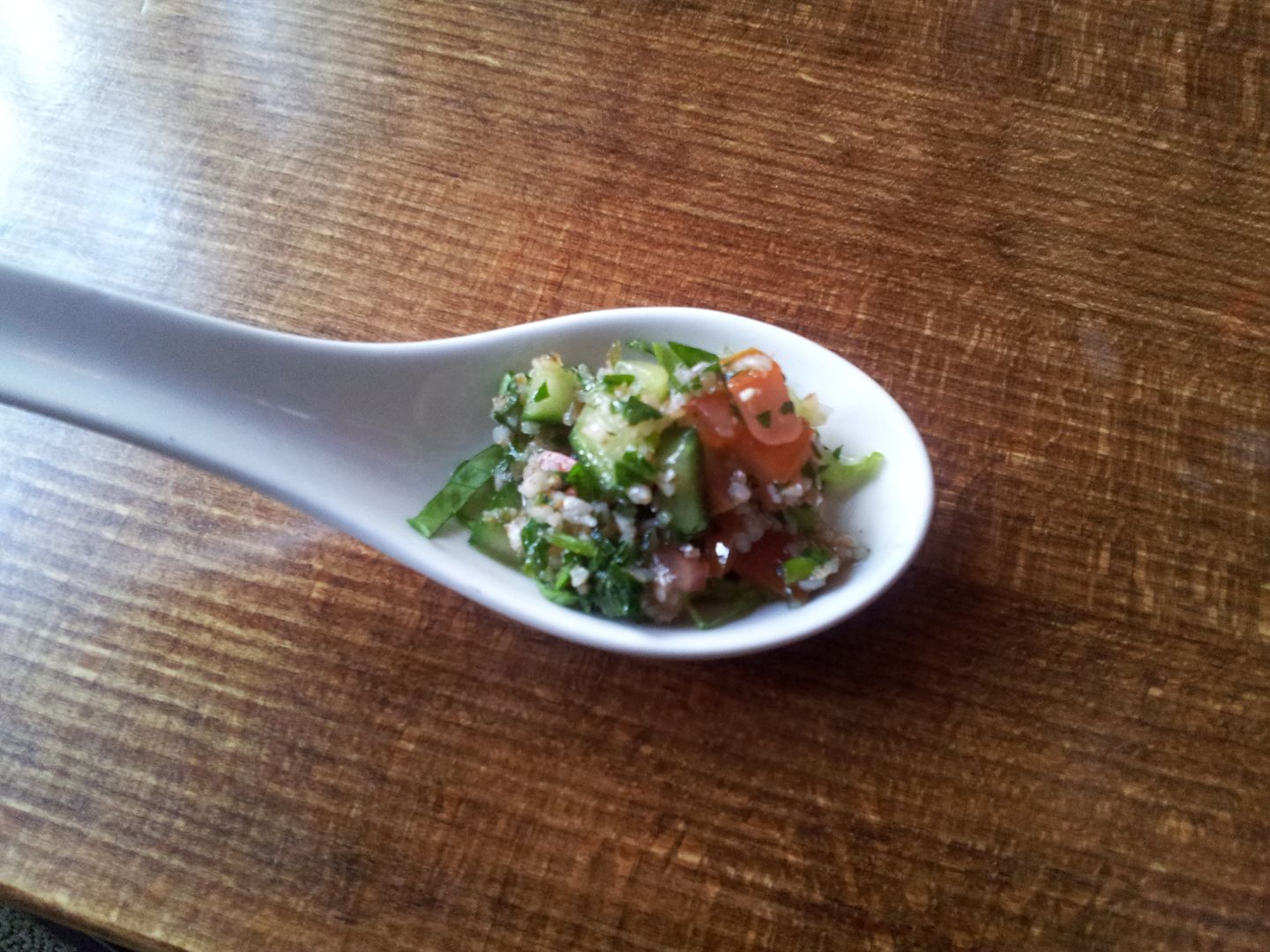
There was also some delicious, almost refreshing tabouleh (the ubiquitous bulgur wheat and herb salad of the Middle East, here with some chopped tomatoes too), and some toasted flat breads with a Lebanese version of what we perhaps more commonly know as tzatziki, here using Stosie's home-made yoghurt.
Tabouleh
Flatbreads and yoghurt dip
Chateau Musar, Musar Jeune Rosé, 2011
This has a bright attractive pink colour. There are strawberries & pomegranate on nose with a hint of minerality. Nice soft on the palate, this has gentle sweetish red fruit with a nice pleasant character. Very clean finish. This is a good rosé with a nice, interesting character. 88/100
After moving through to the dining room, there was more Khobez flatbread, now with a powerful za'atar herb oil for dipping, which was rapidly mopped up by our table.
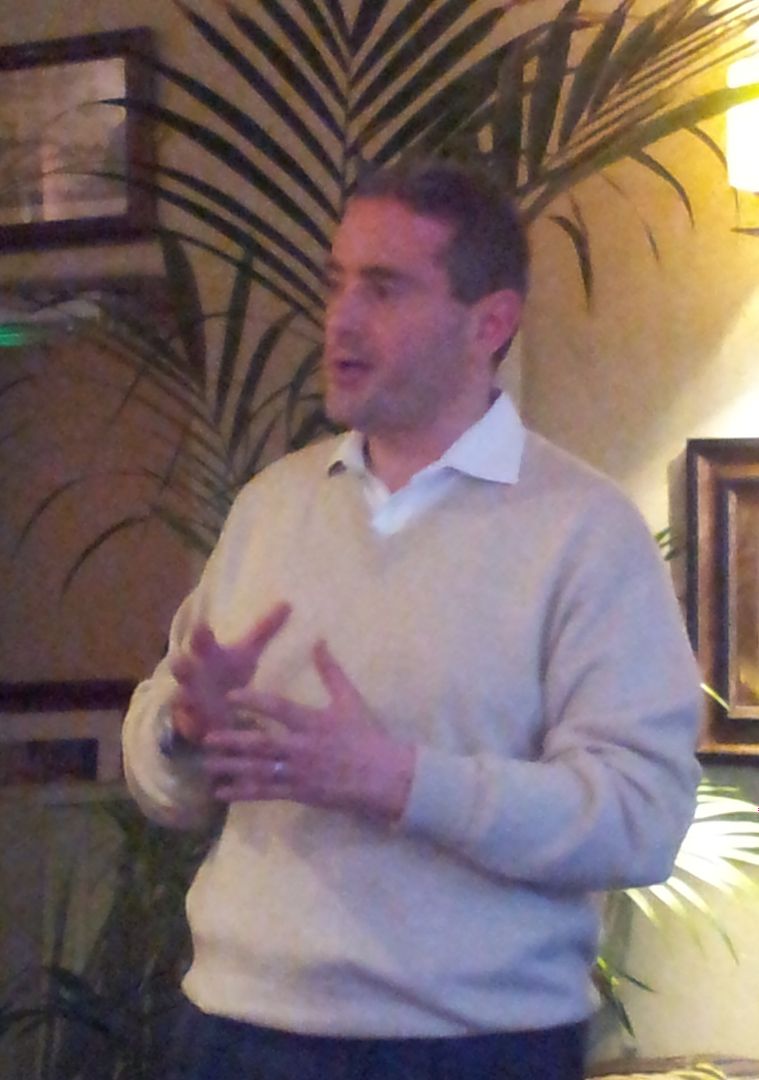
Ralph Hochar briefly introduced the wines
The first real course of the meal was a fascinating Chorba Mloukhiyeh - a chicken and Jew's mallow broth, with Goosnargh chicken, shallot vinegar, puffed wild rice and yet more flatbread, here crispy, which we were instructed to crumble into the soup. I really liked this, though it was a dish which needed to be eaten as a whole in big mouthfuls, allowing all the flavours and textures to meld together, rather than picking at individual elements. My first taste of the odd, almost okra like slimeyness of Jew's Mallow.
Chorba Mloukiyeh without the broth ...
... and with the broth
The Chorba Mloukiyeh was served with Chateau Musar, Musar Jeune Rouge 2010
A big blackberry-laden nose. There's powerful black fruit on the palate. Ultimately, it's a fairly simple wine, but gains some complexity from the drying tannins on the finish. 87/100
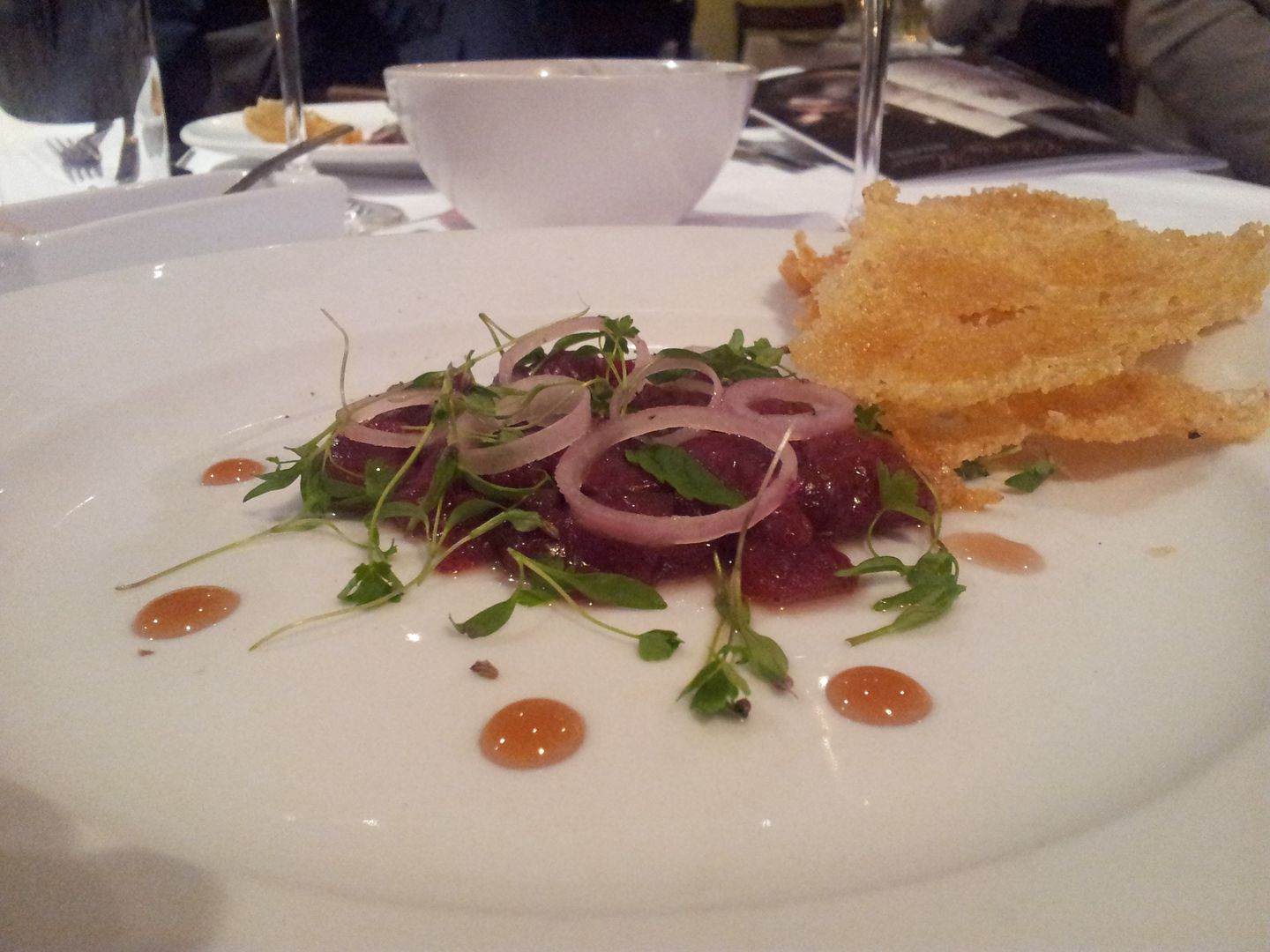
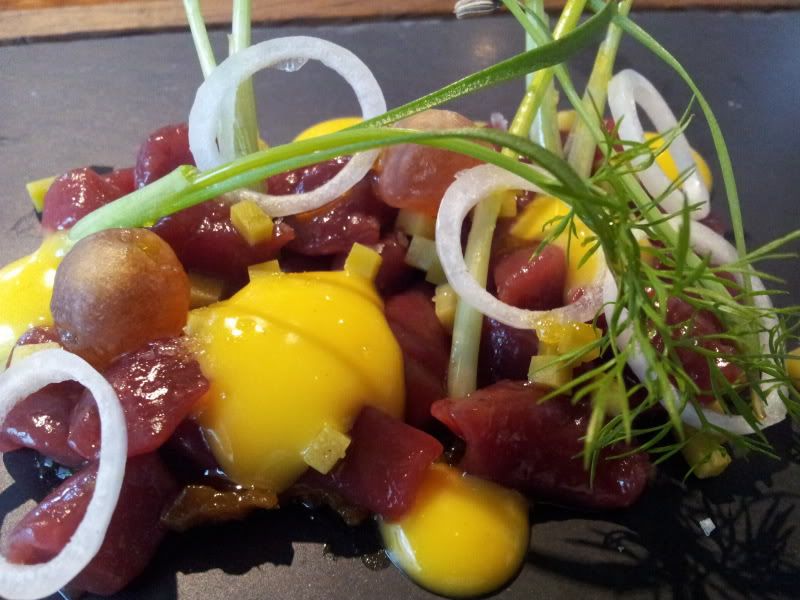
Kibbey Nayeh was probably the dish that had been most adapted to the Lancastrian palate, as rather than being made with pulverised raw lamb, this was a hand-chopped venison tartare. There was a superficial resemblance to Simon Rogan's venison tartare dish, but really it was only superficial. The Parkers Arms version had a superb, delicate middle-eastern spicing, counterpointed by the dots of pomegranate molasses, and the cracked wheat crisps added more of a crunch than Rogan's version has.
Kibbey Nayeh
Just for fun, here's Simon Rogan's venison tartare from a meal at L'Enclume in May 2013
I've thought about it several times, and while it's a little unfair to compare such different dishes, I find it really difficult to say which I prefer: both are excellent in their own ways.
The Chateau Musar, Hochar Père et Fils 2007 was served with the venison:
The Hochar Père et Fils is made only in a red version. It isn't a second wine of Musar as such, but rather is sourced from a single vineyard planted over 50 years ago near the village of Aana in the Bekaa Valley. The wine has a lovely, integrated nose with red and black fruits, and more than a touch of
cough medicine. Really good palate: it feels very integrated with some nice
spicy notes. Great length. 90/100
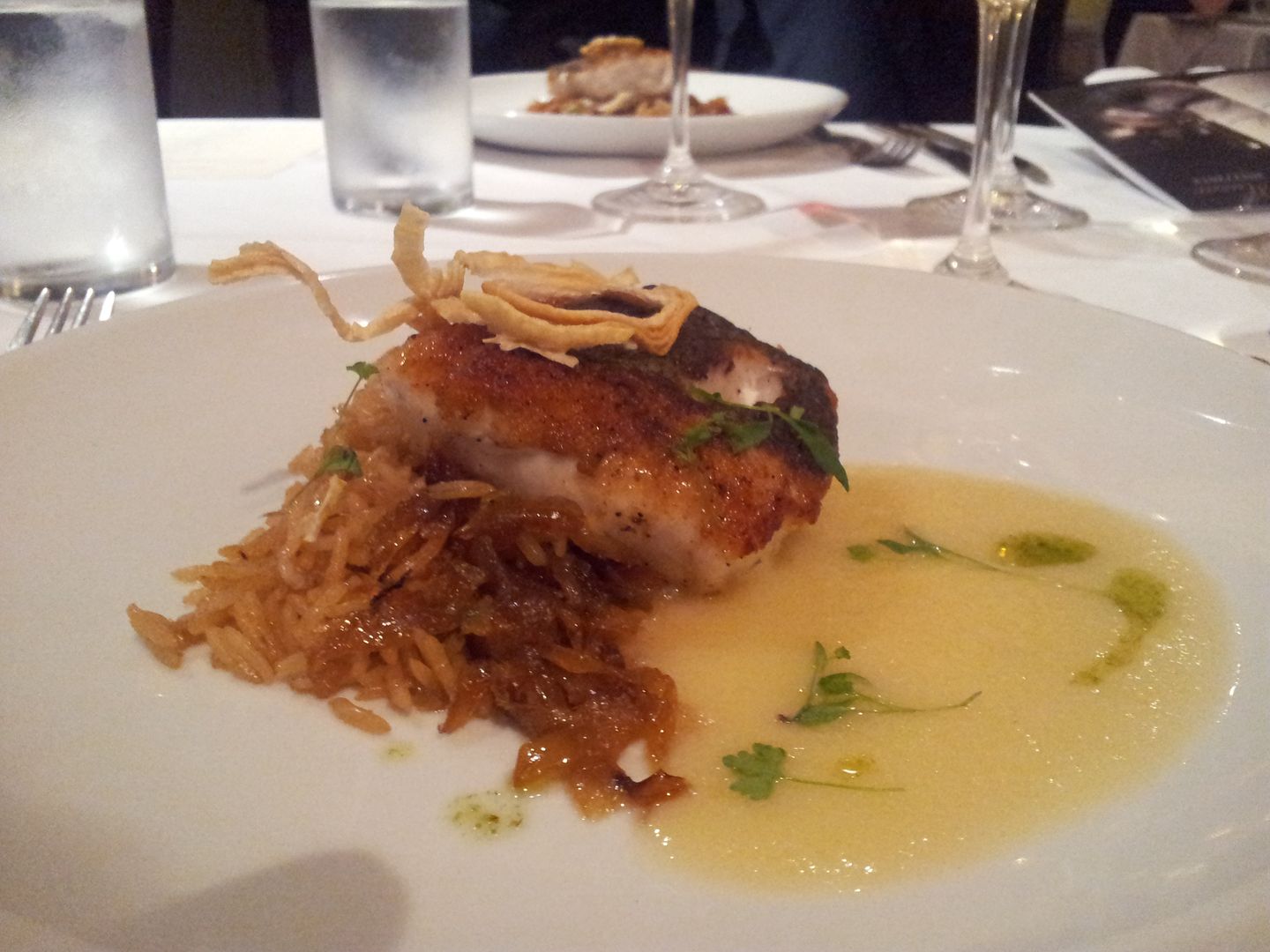
Our next course was eagerly anticipated by me, as I'd had the accompanying rice with fish at the Parkers Arms before: Siyadiyeh - roast, spiced hake served with a caramelised onion pilaf and a buttery lemon sauce. Nicely cooked fish (not always that easy when you're doing a banqueting style service), with the rice living up to expectations, and the sauce utterly delicious.
Siyadiyeh
The wine with the hake was a bit of a treat: the completely unique Chateau Musar white - not a terribly old version (it ages amazingly), but drinking very well and served, correctly, at room temperature.
Chateau Musar White 2005
This has a mushroomy, nutty nose with hints of lanolin ... and lots lots more.
Fascinating palate, almost defying description. It has a rich, velvety texture.
"Multi-layered" hardly suffices to describe its complexity. Really fascinating, gorgeous stuff.
Lots of umami. Remarkable. 93/100.
Lahem Meshwi came next: charcoal-grilled marinated lamb from the Cockerham salt marshes, served with aubergine confit and purée, grilled onion, confit garlic and a lemony lamb jus dressing. Beautiful lamb, terrific flavours.
Lahem Meshwi
Oh, and there is no way I could not give a special, separate mention to these amazingly good lamb-fat and za'atar roast potatoes. Wow.
With the lamb, we drank the last of the wines, the prime cuvée, the Chateau Musar Red: Chateau Musar Red 2005
The nose has some subtly perfumed red fruits with sous-bois notes, but also some horse
sweat notes. There is huge depth immediately on the palate. Musar usually only starts to show it's best after some years, but for such a young Musar, this has a really remarkably
classy feeling. It's very poised, elegant and rather feminine. There's a good tannic
structure to give some backbone, but the tannins are not at all aggressive. Is there such a thing as an early
drinking Musar? This could be it. 93/100
We then moved on to some generous pours of Musar's Arack. Chateau Musar L'Arack de Musar
A very good clean arack. Not much more you can say. Although we all try it neat, it's not something to drink neat: Ralph Hochar recommends one part arack to two parts water.
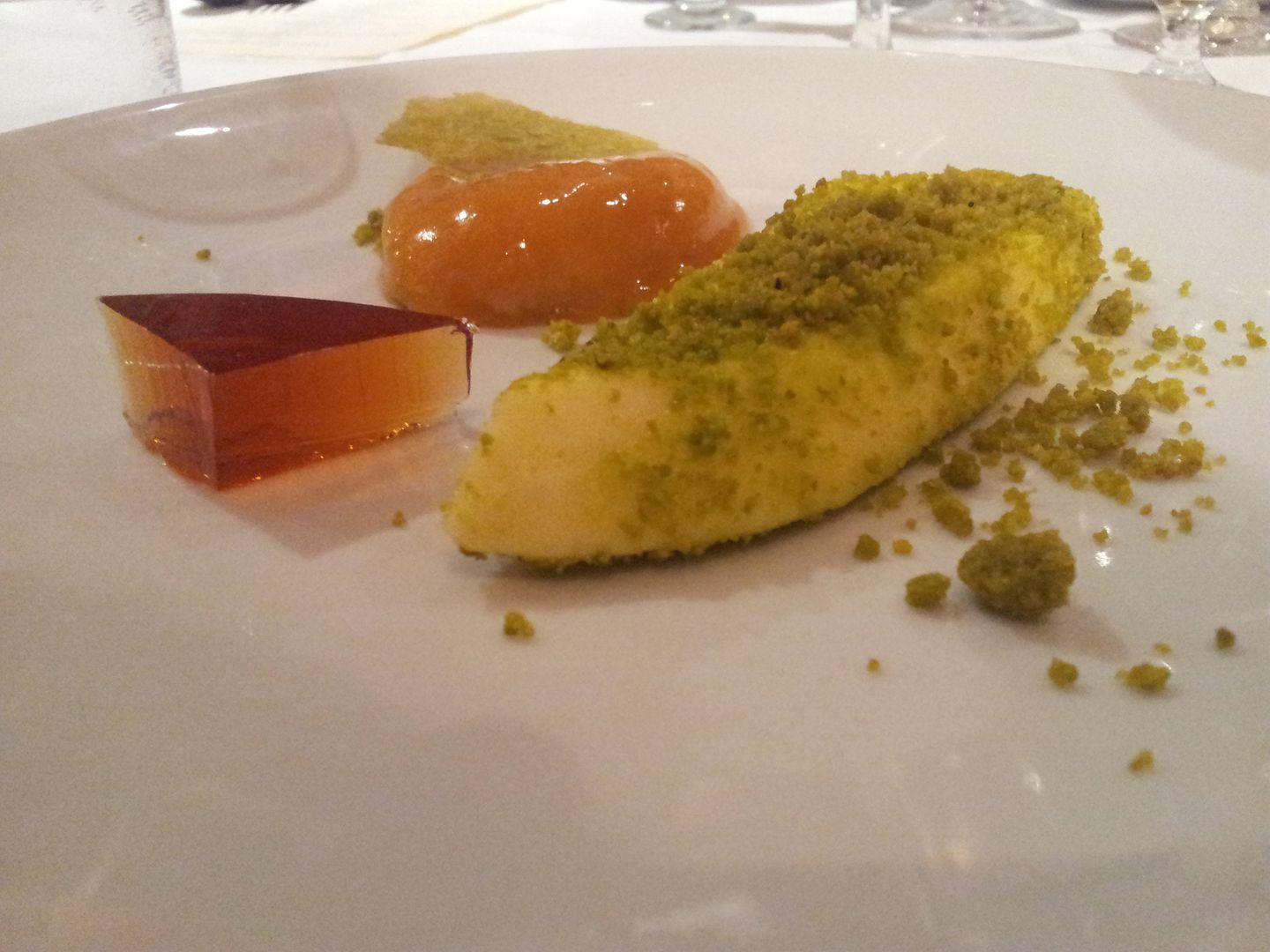
Arack (the aniseed spirit made and drunk across the Middle East, Turkey and Greece) would not have come immediately to mind as something to drink with a fresh curd cheese, but I thought it actually worked pretty well with the next dish. Gibneh Beida was Stosie's home-made soft, fresh curd cheese made with milk from Gisburn, rolled in a pistachio crust and served with a pistachio tuile, a bright, clear, rosehip jelly and an unctuous Amar el Din (i.e. apricot) sorbet.
Gibneh Beida
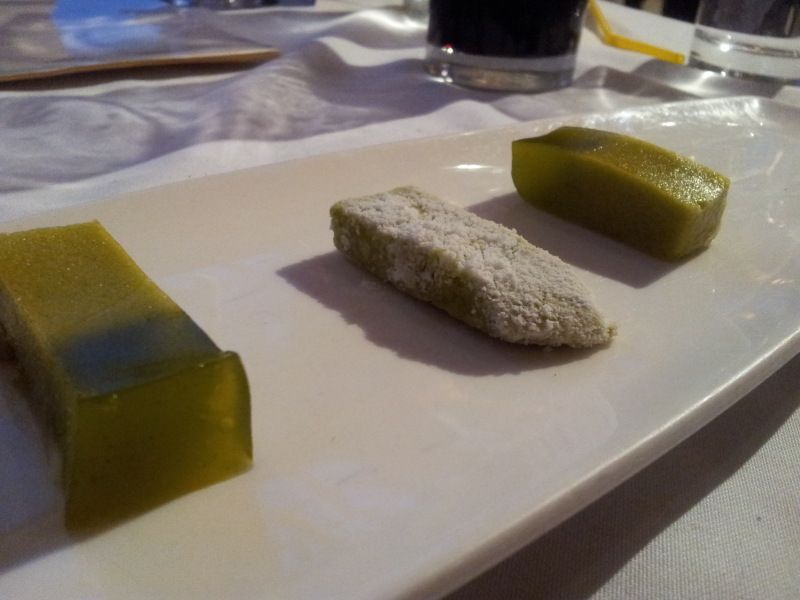
The Arack was much more of a natural partner for the final instalment of an excellent evening of food and drink: Qahwa, Halwa Makroun bil Loz & Namoura. Coffee subtly infused with cardamon, and served with two utterly delicious, incredibly moreish sweetmeats: some almond shortcakes and what the menu said was a semolina and elderflower syrup cake, but was actually two different syrup-laden cakes.
I hope it will be possible for the Parkers Arms and Chateau Musar to repeat this event next year, maybe, and also that it might mark the start of more wine evenings, allowing Stosie Madi to express further aspects of her heritage. Hmmm ... could lamproies à la Bordelaise be one step too far for the Ribble Valley?
I like Paul Heathcote, or Paul Heathcote, Esq. MBE as he should properly be called: he's a good bloke and a mighty fine cook. I've followed his work and been on nodding terms with him almost since he first moved back home to Lancashire to run the kitchen at the Broughton Park Hotel (now the Preston Marriott), though I may well have eaten his cooking before when he worked at Sharrow Bay or under the great Michel Bourdin at the Connaught Hotel in London.
He moved on from Broughton Park in 1990 to open his own restaurant in Longridge that became the 2-Michelin starred flagship for a large, varied group of restaurants across the north west. Paul Heathcote's two remaining restaurants are both in the same building in Preston's Winckley Square. The Olive Press is downstairs, and the Brasserie is upstairs, both with a completely different vibe.
The Brasserie is a big space (I wasn't even in the main room, which remained unused) and on the December lunchtime when I popped in for this meal, there were only two other tables occupied, so it felt a little soulless, and staff managed to do that being too busy being at a loose end to be entirely effective thing.
The menu is attractive, with plenty of interest, and in addition there was (I realised later) a good value set lunch, which I wasn't shown.
Bread was a nice fruited malt loaf came, but the single slice in the bottom of the rustic little box looked a bit mean, smacking a bit too much of tight portion control.
I started with black pudding fritters with poached egg, buttered peas and lettuce. The latter two elements, with some unadvertised lardons and pearl onions, made a very good petits pois à la française. Heathcote's black pudding used to be one of his signature dishes (and has returned in its classic 2-star form to the menu since this visit): here too, the black pudding was homemade, the breading light, and the frying clean. A very good dish; light and yet satisfying at the same time.
Heathcotes black pudding fritter, poached egg, butters peas and lettuce
One service failure came when the first course plates were cleared: they were put on a tray on a stand which had been brought to the table, and then left there, until the mains came. Bizarre.
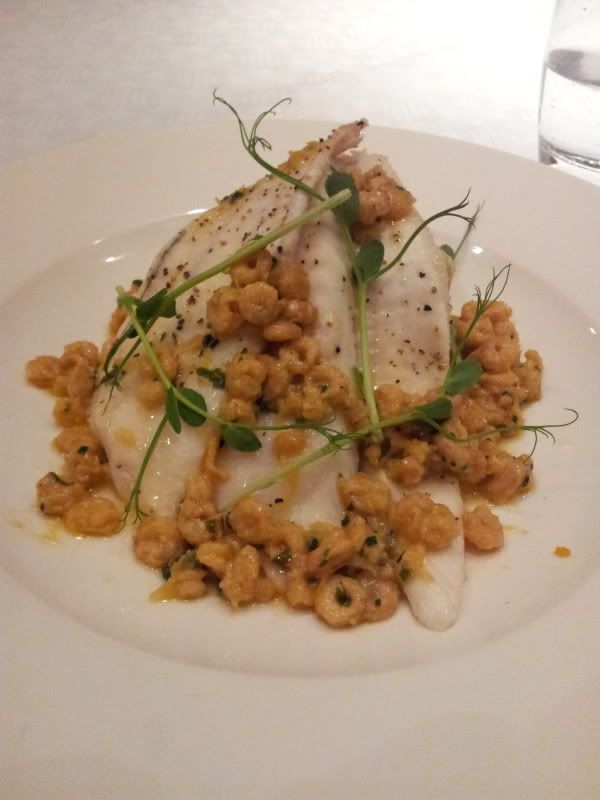
My main course was an excellent dish of lemon sole (coyly called Morecambe Bay sole on the menu, presumably allowing cheaper soles to be substituted if necessary) with crushed potatoes and a very generous helping indeed of warm potted shrimps. A whole sole with what must have been getting on for a fiver's worth of shrimps retail for £17.50 was good definitely good value. The sole was cooked absolutely bang on, and the whole dish hung together really well. I was impressed.
Morecambe Bay sole, crushed potatoes, warm potted shrimps
I didn't have dessert this time, but if you go, do bear in mind that there is no finer bread and butter pudding than Paul Heathcote's.
So, on this brief visit, excellent food, let down a bit by front of house staff and setting, though I think the FOH failings were all down to them being too quiet.
Mezzo Italian Restaurant & Bar Preston New Road Salmesbury PR5 0UP
YAFI, as Manchester Confidential would say (see the Guardian on Britain's obsession with Italian restaurants here). Yet another identikit Britalian pizza pasta joint, I'd say. Of course, this is what a lot of customers want, and you can't blame restaurateurs for responding: they're in it to make money, not act as charitable foundations for foodies.
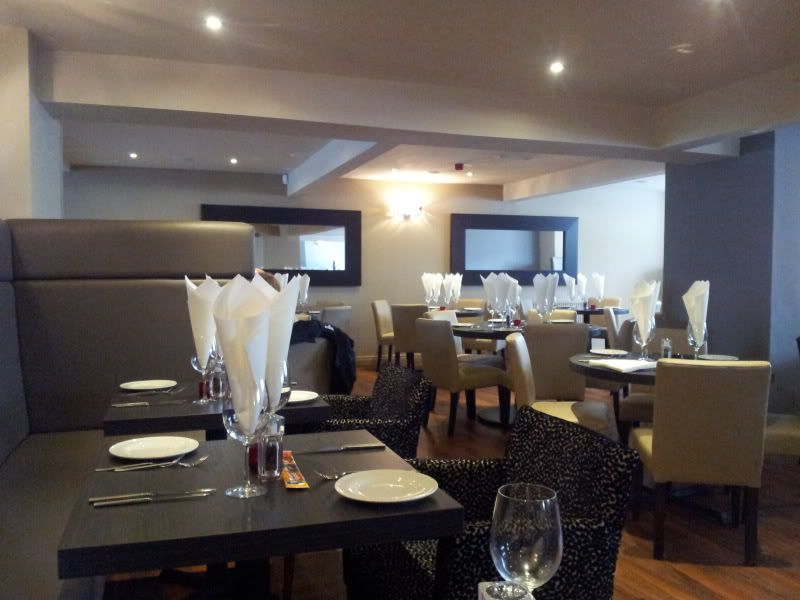
A lot of money has obviously been spent doing up what had been a grotty Italian (itself converted from a roadside pub) that had closed down some time ago. The money's resulted in a lot of bling, that I just find tacky, and formulaic. Blue neon signs outside, black ash tables, paper napkins in glasses, open kitchen, desserts ready made and plated in a glass fronted fridge, grissini in plastic packs on the table. Grissini were novel in 1973, but by about 1978 most people had realised that these crisped up bits of cardboard had no merit whatsoever.
Mezzo's dining room
We went for lunch, without booking. The restaurant was empty when we arrived (two other tables, a two and a four, arrived after us). Service seemed irritated to have to be there. We were seated on what pretty much seemed to be the nearest table to the entrance, by the waiters' station. A pretty duff table by any measure, and not helped by having a wall-to-ceiling wine display case towering over us, which was both claustrophobic and also hid us from the waiters.
Plastic laminated menus were brought, and the aperitif order taken: Aperol Spritz was a very good example. When a waiter came to take orders, we asked if there were any specials on today. He looked surprised at the request, but went away and brought us a paper specials menu. Sorry, but why not give customers the specials menu without them having to ask for it?
The menu is part standard Britalian (spaghetti carbonara, penne arrabiata, pizza, veal escalope with mushrooms in cream sauce, bruschetta, stuffed mushrooms), and part blast-from-the-past (salmon and prawns with marie rose sauce, steak with peppercorn sauce, scampi thermidor, sole in pernod and cream sauce, duck with orange sauce, and of course there's a version of Chicken Kiev), all wrapped up in Italian names. I have to say, I'm much more a fan of the latter than the former: these old seventies classics can still be highly enjoyable dishes when done well.
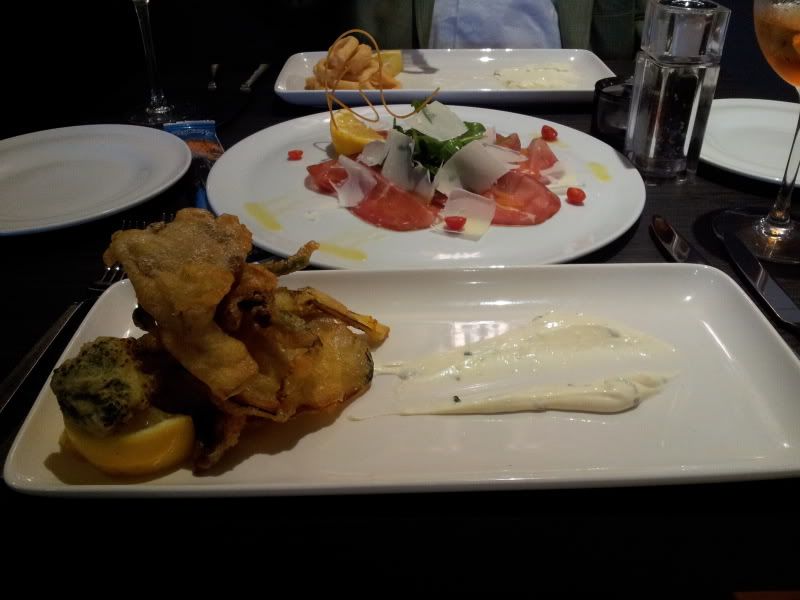
We asked for some bresaola to start with to share, to be followed by calamari fritti and verdure fritte (deep fried vegetables with some garlic mayonnaise). All three came together, which meant moving most other things off the table to fit them on. To be fair, both calamari and veg fritters came on long plates, with the food piled up at one end, so we'd still have had to move side plates and glasses to accommodate the size of the plates on the small table. Surely it's a simple basic calculation all restaurateurs should be able to make: will the plate fit on the table? It's not even as though a plate that size was necessary.
Calamari in the distance, bresaola in the middle, and deep fried vegetables in the foreground
Note our side plates have had to be moved to the centre of the table so the rectangular plates would fit.
The bresaola was fine, but didn't strike me as anything special. Calamari were good if similarly undistinguished, though looking at that picture above, it strikes me that you don't get a great deal of squid for £7.
The vegetable fritters would probably have been better if they'd not all been chucked in the fryer together, and so came all pretty much in one clump.
Sirloin steak tagliata was pretty good. You have to admire Italian restaurants for turning slicing a grilled steak and sprinkling a bit of olive oil on it into a dish.
Scampi thermidor
My scampi thermidor (or thermador, as the menu had it) was actually very good and the real star of the whole meal. Beautiful langoustines, very gently cooked in a nice sauce that didn't overpower the scampi.
We didn't have desserts largely due to them being utterly uninspiring, but also because they seemed to be all pre-portioned and pre-plated in a fridge between the kitchen pass and where we were sat.
We had espresso and a macchiato, both of which were very good. So good that we ordered second coffees. Why on earth would the waiter bring a second pot of sugar sachets? Why would he put the new sugar pot on the table next to the one that was already there? Come on: wake up! If we'd had a third espresso, would we have got a third pot of sugar?
A lot of sugar for two coffees. Always useful to have the salt and pepper for the coffee too...
The wine list does that Britalian thing of pretty much listing only the DOC (or other designation), with no vintages or producers: the only producers mentioned are those of the champagnes. Why do so many such places do this? I don't know about you, but it makes me feel like they have a really low opinion of their customers: "you don't need to know details, you won't understand things like vintages and producers." I suppose, as most of it is under £25 a bottle here, there's not likely to be much of any note or interest.
I've been neglecting this blog for a while, but prompted by two things, an acquaintance having the great fortune to visit Serge Hochar and Chateau Musar in Lebanon, and by a forthcoming Musar evening at the excellent Parkers Arms in Newton in Bowland, I've realised I have never published my notes from an exceptional tasting of Musar, hosted by Serge Hochar, with assistance from Steven Spurrier and the late John Avery.
The tasting was held at the London International Wine Fair in May 2009, and was a rare opportunity to meet Serge Hochar in this country and taste through some exceptional, and exceptionally mature vintages of his wines.
Wines have been made in Lebanon for centuries, if not millennia. But the story of Chateau Musar begins in 1930 when Serge's father, Gaston Hochar (pronounced Hoe-shar) planted his first vines in the Bekaa Valley.
The Bekaa Valley lies further south than vineyards of France and Spain, but the hot sunny conditions are tempered by the altitude, with the Musar vineyards lying around 1000 metres above sea level. The vineyards for the red wines are located towards the southern end of the Bekaa Valley, north of Lake Quaroun, about 30km south-east of Beirut. The main red varieties are Cabernet Sauvignon, Cinsault and Carignan. The indigenous white varieties, Obaideh and Merwah, are planted at higher altitudes on the mountain slopes, up to 1500 metres above sea level.
Unusually the winery is not located near the vineyards, but around two and a half hours' drive away. Apparently this is because, when Gaston Hochar established Chateau Musar in 1930, the boundaries of Lebanon were not yet formally agreed, but he wanted to make sure that the winery would be within the new country of Lebanon. As a result, the winery was built in the family's 18th century castle, overlooking the Mediterranean at Ghazir, about 25km north of Beirut. The name "Musar" comes from the Arabic name of the place, M'zar.
As the company expanded, new cellars were built into the mountainside nearby. These deep cellars not only provide good conditions for maturing wine (as is evidenced by the ready availability - at a cost - of many older vintages of Musar), but also were so solid and secure that they were used by the villagers of Ghazir as air raid shelters during Lebanon's long civil war. Musar has gained a mystique all of its own from the fact that during the 15 years of civil war (between 1975 and 1990), only one harvest was missed (1976), with grapes being picked under shell-fire. The 1984 vintage has never been released: war had prevented the grapes being pick in late August (the usual picking time), and the harvest was not completed till October!
Chateau Musar red is made from cabernet sauvignon, carignan and cinsault: according to Serge, the cabernet forms the backbone of Musar, the carignan the meat, and the cinsault forms the skin. The wines are fermented in cement vats, racked after about six months and then aged for around a year in French oak. The different varieties are then blended to reflect the strengths and characteristics of the vintage (which in practice means that Chateau Musar can vary enormously in style from year to year) and is bottled, unfiltered, at the end of the third year after harvest. The wine is then aged for a further three or four years in bottle before being released for sale.
Red Musar has almost cult proportions, which is odd in a wine that is inherently so inconsistent, and often laden with things such as volatile acidity and brettanomyces, that elsewhere are regarded as faults. In some years, it can be positively Burgundian in style, in other years more Bordeaux or Rhone-like. But there's always that little air of wildness and danger in it.
If the red Chateau Musar can be unusual, the white version is on first acquaintance positively weird. It's made from the indigenous varieties obaideh and merweh and is a white wine that is best drunk at room temperature. It ages magnificently. If forced to say what it's like, the nearest I could possibly come up with would be aged, slightly oxidised white Rhône. But it's not really like that.
Serge Hochar is a writer's dream. He is a salesman, a winemaker (though the actual winemaking is now left to others) and something of a Yoda in his pronouncements, which can be at once forthright and cryptic. Asked about perceived faults in his wines, for example, he simply replied "I like brett, and volatile acidity helps my wine to age."
The Wines
2002 Chateau Musar
There's bright cherry fruit on the nose, and then lovely, bright fruit on the attack. Then you feel some fine-grained tannins. Then a sort of dishwater thinness on the middle, before returning to full power on the finish. 89/100
1993 Chateau Musar
There's lovely, earthy red fruit on the nose, which is very warm and inviting, with a slight hint of orange peel.
Lovely palate: very open and inviting with warm fruit. There's some very good elegance here. Nice sweet, slightly raisined fruit characters come along towards the finish. Enormous length. 91/100
1977 Chateau Musar
Old furniture and boot polish on the nose. A very mature feel on the attack, but it becomes younger as you hold it in the mouth. Very balanced with scarcely any noticeable alcohol. This is really nice. There's a lot of character here, but no excess VA etc. In fact there's not much noticeable VA at all. Towards the finish, it feels like it's drying out a little. 91/100
Coming back to it after the 1969, there's a hint of raspberry jam on the palate, and it's really developing in the mouth and becoming much more lively. 93/100
1969 Chateau Musar
On the nose this is much young and fresher than the 1977. There are soft, mature red fruits; warm, gentle, woody spice and a faint hint of curry.
Superb palate. Evolved, mature, but with a lovely red fruit freshness. There's a good tannic structure still persisting. It lingers in the mouth for ages. Much more youthful than the 1977.
Returning to it after a little time, the tannins seem more evident. 94/100
1959 Chateau Musar
This was Serge Hochar's first vintage as winemaker and so also not really the Musar that Serge wanted to make: he reckons it took him until 1977 to finalise the "formula" for his red wines.
It has a
mature, browning colour. The nose is mature, with
polished oak furniture. After aeration, some raspberry and strawberry fruit
become evident.
The palate is notably mature, no doubt, and the attack
reminds me of old wardrobe doors with nice, sweet, evolved fruit. But there's
also a certain vibrancy in there. Some sweet, remarkably young-feeling fruit
comes along. There's a streak of really pure, fresh fruit in there. Remarkable
wine. Very complex flavours.
I reckon there is still enough structure to see this through
a couple more decades.
Serge called up Steven Spurrier and John Avery to help
him describe it: Spurrier describes it as a "non-facelifted, non-botoxed fifty
year old wine", while Avery reckons it reminds him of a madeira, without
fortification. Hmmm ... In complexity, maybe, but I don't find any maderisation.
96/100
2003 Chateau Musar Blanc
On the nose, there are candied almonds and roast
orange peel; slightly waxy feel. Remarkably fresh palate, with some lovely,
fresh, red fruits in the mouth. Totally blind, you could easily guess this was
pinot noir, though admittedly an avoidable one. This is nowhere near ready to
drink yet (apparently it was only released for sale 2 days previously). Serge
reckons it will start drinking in 2023! 88/100
1989 Chateau Musar Blanc
According to Serge Hochar, this is the youngest
white Musar that's currently ready to drink. It's got a rather more waxy nose
than the 2003, with some butter and some citrus. Lovely, fresh palate, with a
delicious savoury edge. Pretty indescribable.
Serge called on Steven Spurrier
to help him describe it, but it defeated Spurrier.
"This wine is made for
gods, it's not made for humanity" said Serge, though I think he'd be quite happy for lots of humanity to buy it. 91/100
In addition to the Chateau Musar 'grands vins' (of which there is an occasional rosé, which blends red and white wines in the manner of some champagnes, rather than the more usual rosé de saignée method of making rosé wines, which merely involves minimising skin contact), Musar have also started producing a number of lesser wines. To my mind, these are not the real Musar, and tend to be more international, and more consistent in style.
The closest in style to Chateau Musar are the Hochar Père et Fils reds. There is a range called Mosaic that is intended for the on-trade, and another new-ish range of red, white and rosé wines made for immediate drinking, without any exposure to oak in the winemaking process: these are variously called Musar Cuvée or Musar Jeune.